
The Saints
St Joseph, Patron of the Universal Church
Who St Joseph is, what he is the patron saint of, a traditional St Joseph prayer, and his feast day in the pre-1958 calendar.
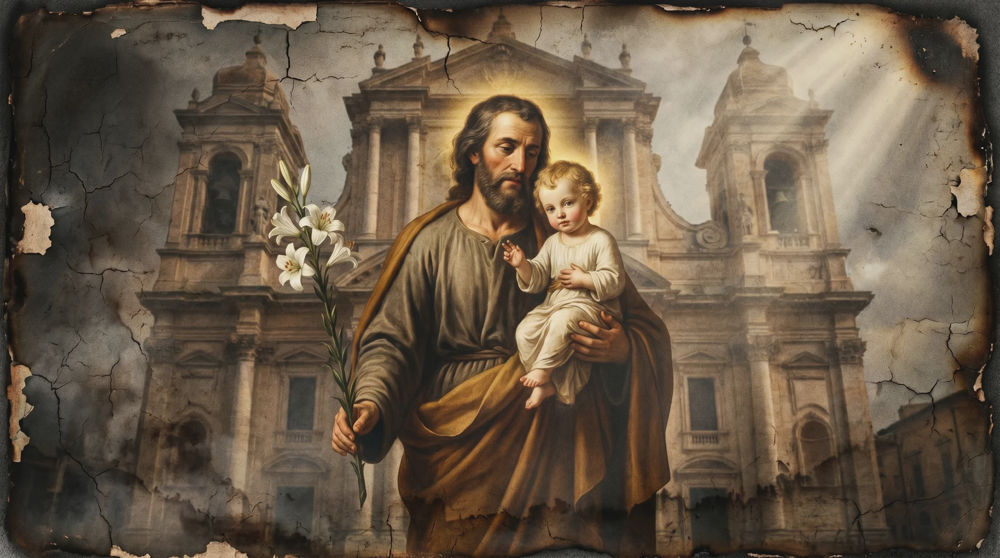
St Joseph is the spouse of the Blessed Virgin Mary, the foster-father of Jesus Christ, and the patron saint of the Universal Church. The Gospel sums up his whole sanctity in a single word: he was a just man (Matthew i, 19). The Church venerates him second only to Mary, and Pope Pius IX, in 1870, declared him Patron of the Universal Church.
Who St Joseph Is
Of the saint himself the inspired writers say little, yet that little is enough. Joseph was of royal descent, his genealogy set out by both St Matthew and St Luke, for he was of the house and lineage of David. By trade he was a carpenter, an ordinary manual labourer, and it was Joseph's trade that the Son of God learned at Nazareth. Betrothed to Mary, the purest of virgins, he was troubled when he found her with child, until an angel set his fears at rest: that which was conceived in her was of the Holy Ghost (Matthew i, 20). Heaven had designated him alone as worthy of so great a treasure, and the tradition recorded by Dom Guéranger holds that the rod he carried in the temple suddenly flowered, marking him out above all other suitors as the guardian of the Virgin.
His life was hidden and obedient. Warned by an angel, he took the Child and His Mother and fled into Egypt; warned again, he brought them back into the land of Israel. To Joseph alone the angel delivered the commands concerning the flight and the return, and he, with Mary, gave the Infant the name of Jesus. Joseph and Mary were poor, as the offering of a pair of turtle-doves at the Purification shows. He held no office, worked no recorded miracle, and spoke not one word that Scripture preserves. He simply did, in silence, what God asked of him. That hidden fidelity remains the school of lay sanctity in every age; the young layman Pier Giorgio Frassati lived the same silence at Turin, in daily duty and a charity kept carefully out of sight.
This is why the Church loves him. As Dom Guéranger writes, the Son of God, descending to take our nature, would have a Mother whose honour needed a protector, and this privileged mortal was Joseph, the most chaste of men. He exercised over the very Son of God an adopted paternity. Cardinal Schuster goes further: Joseph was not merely the putative father, but the true representative of the eternal Father's authority, invested with the patria potestas in the Holy Family of Nazareth.
What St Joseph Is Patron Saint Of
When people ask what St Joseph is the patron saint of, the first and greatest title is the one given by Pius IX: Patron of the Universal Church. The reason is drawn directly from his office at Nazareth. As under Joseph's paternal authority God was pleased to bless the first beginnings of His earthly household, so the Church, which is the household of God grown to fill the world, venerates him as her special guardian. The man who protected the infant Christ from Herod is fittingly invoked to protect the Mystical Body of Christ in every age.
He is, secondly, the patron of workers. Saint Joseph the Worker is the title under which the Church honours the labourer of Nazareth, the just man who supported the Holy Family by the work of his hands. Against every error that despises honest labour, or that exalts it into an idol, the carpenter of Nazareth stands as the model: work offered to God, in poverty, without complaint. The toil of his shop sanctified human labour from within, because the Child who handed him the nails was God.
Thirdly, he is the patron of fathers and of the Christian household. Schuster calls the obedience of Nazareth an example for all superiors in the Church of God: Jesus is last in the house and obedient to all; Mary commands her divine Son yet yields obedience to Joseph; and Joseph, obeying the eternal Father, serves and governs both. Fathers who would govern well have here their pattern, ordered authority exercised in humility and prayer. This is the same school in which all Christian marriage is meant to be lived.
Fourthly, and most consolingly, St Joseph is the patron of a happy death. Tradition holds that he died at Nazareth in the arms of Jesus and Mary, the two persons whom every soul most longs to have near in its last hour. No man ever died better attended. For this reason the dying have for centuries placed themselves under his protection, that he who fell asleep between the Son of God and the Mother of God might obtain for them a holy passage out of this life. The hour of death is the hinge on which eternity turns, and Joseph is its sure advocate.
A Traditional Prayer to St Joseph
The Church has long prayed to St Joseph as the protector of the faithful. The following St Joseph prayer, drawn from the older devotional tradition, asks his intercession for the Church and for a holy death:
To thee, O blessed Joseph, do we have recourse in our tribulation, and having implored the help of thy thrice-holy Spouse, we confidently invoke thy patronage also. By that charity wherewith thou wast united to the Immaculate Virgin Mother of God, and by the fatherly love wherewith thou didst embrace the Child Jesus, we beseech thee and we humbly pray that thou wouldst look graciously upon the inheritance which Jesus Christ hath purchased by His Blood, and wouldst succour us in our need by thy power and strength.
Most watchful Guardian of the Holy Family, defend the chosen offspring of Jesus Christ; keep far from us, most loving Father, all blight of error and corruption; mercifully assist us from heaven, most mighty Protector, in this our conflict with the powers of darkness; and, as once thou didst rescue the Child Jesus from deadly peril, so now defend God's Holy Church from the snares of the enemy and from all adversity; shield, too, each one of us by thy constant protection, that, supported by thy example and thy aid, we may be able to live piously, to die holily, and to obtain eternal happiness in heaven. Amen.
This prayer pairs naturally with the older devotions of the Church: the Litany of St Joseph, which gathers his titles into a single supplication, and the Memorare, addressed to his most holy spouse. Because Joseph is patron of a happy death, devotion to him is also a sober preparation for what happens after death, the particular judgment that awaits every soul.
The St Joseph Novena
A St Joseph novena is nine days of prayer asking his intercession, kept most fittingly in the nine days leading up to his feast on 19 March, though it may be made at any time of need. The Church has long encouraged this devotion; Pope Leo XIII, in the encyclical Quamquam Pluries (1889), prescribed prayers to St Joseph and so confirmed the practice of turning to him in sustained supplication. The form below may be said each of the nine days, followed by your own particular intention:
O glorious St Joseph, faithful follower of Jesus Christ, to thee do we raise our hearts and hands to implore thy powerful intercession in obtaining from the benign Heart of Jesus all the helps and graces necessary for our spiritual and temporal welfare, particularly the grace of a happy death, and the special favour we now implore (here name your request). O Guardian of the Word Incarnate, we feel animated with confidence that thy prayers in our behalf will be graciously heard before the throne of God. Amen.
For the complete nine-day form with the proper prayers for each day, see our full novena to St Joseph. The novena is not a magic formula or a guaranteed transaction; it is persevering prayer, made in faith and conformity to God's will, after the example of the saint who himself obeyed in silence.
The Litany of St Joseph
The Litany of St Joseph gathers his many titles into one sustained invocation, each answered by the refrain pray for us. Approved for public use by Pope St Pius X in 1909, it names Joseph as renowned offspring of David, head of the Holy Family, chaste guardian of the Virgin, foster-father of the Son of God, model of workmen, glory of home life, hope of the sick, and patron of the dying. Its structure mirrors the great litanies of the Church, moving from his dignities to his patronages and closing with petitions for the Church and a holy death. The full text, with versicles and the closing prayer, is given in our Litany of St Joseph.
The Feast Day of St Joseph
The principal feast of St Joseph falls on 19 March, kept in the traditional Roman calendar as a double of the first class. As Dom Guéranger notes, its place in March was likely chosen so that the Church might honour the guardian of the Incarnation in the very season that prepares for the mystery of the Cross, interrupting the austerities of Lent to rejoice in him whom Scripture calls the just man. The cultus grew through St Bridget, John Gerson, and St Bernardine of Siena; Sixtus IV introduced the feast into the Breviary, and Pius IX raised it and named Joseph Patron of the Universal Church.
A second feast, St Joseph the Worker, honours him under his title of labourer and protector of working men. Under either feast the Church turns to the same silent carpenter of Nazareth, the man to whom God entrusted His own Son and His own Mother.
Frequently Asked Questions
Who is St Joseph?
St Joseph is the spouse of the Blessed Virgin Mary and the foster-father of Jesus Christ. He was of the house and lineage of David, a carpenter by trade, and the Gospel sums up his whole sanctity in a single word: he was a just man (Matthew i, 19). The Church venerates him second only to Mary and honours him as Patron of the Universal Church.
When is St Joseph's Day?
St Joseph's Day, the principal feast of St Joseph, falls on 19 March every year, kept in the traditional Roman calendar as a double of the first class. A second feast, St Joseph the Worker, honours him under his title of labourer. The date of 19 March does not change from year to year.
What is St Joseph the patron saint of?
St Joseph is, first and greatest, the Patron of the Universal Church, declared so by Pope Pius IX in 1870. He is also the patron of workers (as St Joseph the Worker), of fathers and the Christian household, and — most consolingly — of a happy death, since tradition holds he died at Nazareth in the arms of Jesus and Mary.
When was St Joseph born?
Scripture does not record the birth of St Joseph, nor does the constant tradition of the Church fix a date or place. The inspired writers are concerned not with his chronology but with his office: he was of the house and lineage of David, betrothed to the Virgin Mary, and chosen by God to be the foster-father and guardian of the Incarnate Word.
How did St Joseph die?
Scripture does not record the death of St Joseph either, but the constant tradition of the Church holds that he died at Nazareth before the public ministry of Christ, in the presence of Jesus and Mary. Because he is believed to have died attended by the Son of God and the Mother of God, the two whom every soul most longs to have near at the end, he is honoured as the patron of a happy death.
Why is St Joseph called the patron of a happy death?
Because tradition holds that Joseph died at Nazareth in the arms of Jesus and Mary — no man ever died better attended. For this reason the dying have for centuries placed themselves under his protection, that he who fell asleep between the Son of God and the Mother of God might obtain for them a holy passage out of this life.
How do you pray a St Joseph novena?
A St Joseph novena is nine consecutive days of prayer asking his intercession, traditionally made in the nine days before his feast on 19 March, though it may be prayed at any time. Each day you say the appointed prayer to St Joseph and add your own particular intention. See our full novena to St Joseph for the complete nine-day form.
What is the Litany of St Joseph?
The Litany of St Joseph is a prayer that gathers his titles — chaste guardian of the Virgin, foster-father of the Son of God, model of workmen, patron of the dying, and more — into one sustained invocation, each answered by pray for us. It was approved for public use by Pope St Pius X in 1909. The full text is available in our Litany of St Joseph.
Go to Joseph. The Church has worn this counsel smooth with use across many centuries, because the foster-father of Christ has never failed those who turn to him. He guarded the Head; he will not abandon the members.
The Iter Fidei app carries the prayers to the saints, the litanies, and the traditional calendar of feasts. Download it here.
Sources. The Holy Bible, Douay-Rheims (Matthew i, 18-25; ii, 13-23; Luke ii, 41-52). Butler, Lives of the Saints (St Joseph, husband of Mary). Dom Prosper Guéranger, The Liturgical Year (Feast of St Joseph, 19 March). Cardinal Ildefonso Schuster, The Sacramentary (Liber Sacramentorum). Pope Pius IX, decree Quemadmodum Deus (1870), declaring St Joseph Patron of the Universal Church. Pope Leo XIII, encyclical Quamquam Pluries (1889). Litany of St Joseph, approved by Pope St Pius X (1909).