
Devotions
The Novena to St Joseph That Never Fails
The traditional novena to St Joseph — the famous prayer 'Ever-blessed and glorious Joseph' and the thirty-day devotion — prayed for a happy death, for work and provision, for the Church, and for causes the world calls impossible.
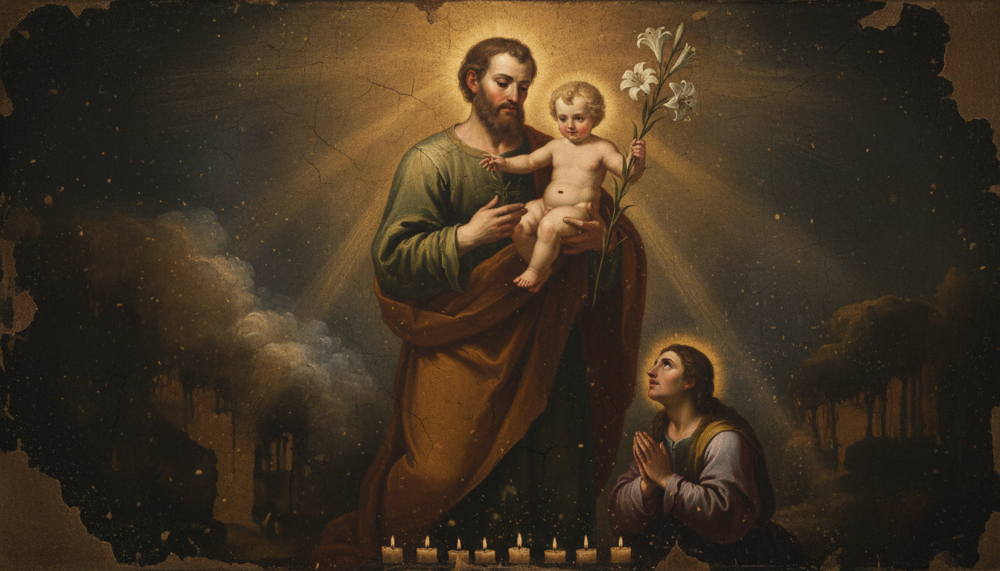
The novena to St Joseph that never fails is the old prayer beginning "Ever-blessed and glorious Joseph, kind and loving father," said nine days running to ask the foster-father of Our Lord for some grace — most often a happy death, daily provision and work, the needs of the Church, or a cause the world has given up as impossible. It is one of the surest of all the saints' devotions because of who St Joseph is: the Patron of the universal Church, the guardian of the Holy Family, and the man who died in the arms of Jesus and Mary. Below we give the prayer itself, the thirty-day devotion, and the reason this confidence is well placed.
Why a novena to St Joseph "never fails"
The phrase is old and devout, not a magic formula. No novena binds God, and no saint can compel Him; to pray as though words coerced an answer would be superstition, which the Church condemns. What the title means is something soberer and surer: that of all the saints, few have a claim on the ear of Jesus like the man He obeyed for thirty years. The Catechism of St Pius X teaches that "it is very useful to pray to the Saints, and every Christian ought to do so," and names first among them, after the Angels, "Saint Joseph, Patron of the Church." A novena to St Joseph leans on that authority. If we still ask what a novena is and why nine days, see our guide to what is a novena; and for the whole life and titles of this saint, St Joseph.
The grace asked is not always the grace given, and a true devotion accepts that. The novena "never fails" not because it always grants the thing we name, but because it never fails to obtain what is better for the soul — and because St Joseph, who provided for the Word made flesh, does not abandon those who put their providing in his hands.
The novena prayer: "Ever-blessed and glorious Joseph"
This is the prayer at the heart of the traditional devotion. It is said once on each of the nine days, with the intention named at the start:
Ever-blessed and glorious Joseph, kind and loving father, and helpful friend of all in sorrow! Thou art the good father and protector of orphans, the defender of the defenceless, the patron of those in need and sorrow. Look kindly on my request. My sins have drawn down on me the just displeasure of my God, and so I am surrounded with unhappiness. To thee, loving guardian of the Family of Nazareth, do I go for shelter and protection.
Listen, then, I beg thee, with fatherly concern, to my earnest prayers, and obtain for me the favours I ask. (Here name your request.)
I ask it by the infinite mercy of the eternal Son of God, which moved Him to take our nature and to be born into this world of sorrow.
I ask it by the weariness and suffering thou didst endure when thou foundest no shelter at the inn of Bethlehem for the holy Virgin, nor a poorer house where the Son of God could be born. Then, in the great joy which filled thy heart at the birth of the Infant Jesus; in the great pain which pierced thy heart at the prophecy of holy Simeon, console my heart by obtaining for me, not only spiritual help and consolation, but also the particular favour I now ask. (Name it again.)
And, as a return for this favour, I will do my best to imitate thy virtues, that I may one day share thy glory, and bless thee for ever in heaven. Amen.
Many add at the close the prayer of Pope Leo XIII, To thee, O blessed Joseph, do we have recourse in our tribulation — the prayer the same Pope ordered said after the Rosary in the month of October. To it the devotion often joins the Litany of St Joseph, approved for the whole Church by St Pius X in 1909, in which the saint is hailed as Patron of the dying, Terror of demons, and Protector of Holy Church.
The four great intentions
A novena to St Joseph is prayed for whatever a soul rightly needs, but tradition has long carried four intentions to him above the rest.
For a happy death
St Joseph is the patron of a happy death, because, as tradition holds, he died at Nazareth in the arms of Jesus and Mary — the two whom every soul most longs to have near at its last hour. No man ever died better attended. For this reason the dying have for centuries placed themselves under his protection, and a novena to St Joseph is among the soundest preparations a Christian can make for that hour — fittingly joined to the reparation of the First Fridays and to a sober study of what happens after death, that we may beg his help with our eyes open.
For work and provision
St Joseph laboured with his hands and fed the Holy Family by the sweat of his brow. He is therefore the patron of workers and of fathers who must provide, and the novena is the natural recourse of those without work, without bread, or burdened with the care of a household. We ask him to provide for us as he provided for the Christ Child.
The St Joseph novena for a job and for employment
Of all the requests brought to St Joseph, the one for work is among the oldest and most fitting, for he himself worked. A St Joseph novena for a job — or for steady employment when work has run dry — leans on the plain fact that he was a tradesman who knew the worry of providing, and who never let the Holy Family go without. The same Ever-blessed and glorious Joseph prayer above carries this intention well; name the work you seek, and add the short petition the workmen of old said to him:
O glorious St Joseph, model of all who labour, obtain for me the grace to work in a spirit of penance for the expiation of my many sins; to work conscientiously, putting the call of duty above my own inclinations; to work with order, peace, moderation, and patience, never shrinking from weariness and trials; and above all, with purity of intention and detachment from self, having always death before my eyes and the account I must render of time lost, of talents wasted, of good undone, of vain complacency in success. All for Jesus, all through Mary, all after thine example, O Patriarch Joseph. Amen.
When praying for employment, ask plainly for the place you need — but ask first for work to do, and for the strength to do it justly. The novena does not conjure a job; it commends a working soul to the man Our Lord obeyed in the workshop, and waits in trust. Many keep this petition through the nine days before 1 May, the feast of St Joseph the Worker (see below).
The St Joseph the Worker novena
A St Joseph the Worker novena is the same devotion turned toward the second of his two feasts. St Joseph the Worker is kept on 1 May, a feast that sets the dignity of honest labour against every false gospel of the world that would either despise work or worship it. Tradition prays the nine days leading up to it for the same intentions of work and provision, often adding the petition above. It is a natural devotion for working men and women, for the unemployed, and for anyone who wishes to sanctify the daily round of duty. The feast is later than the great 19 March solemnity, but the patronage is one: the carpenter of Nazareth who fed God Himself by the work of his hands.
The novena to St Joseph the carpenter
Many know the saint simply as St Joseph the carpenter, and the novena to St Joseph the carpenter is the same prayer said under that homeliest of his titles. The Gospel calls Our Lord "the carpenter's son" (Matthew 13:55) and the people of Nazareth knew Joseph by his trade. To pray to him as the carpenter is to ask the help of a hidden, working saint who sanctified an ordinary craft — and it is the same novena, the same prayer, the same trust, whether we name him the Patriarch, the Worker, or the carpenter of Nazareth.
For the Church
Pius IX declared St Joseph Patron of the universal Church, and Leo XIII's prayer begs him to guard her against her enemies. A novena said for the Church — for her bishops and priests, against the powers that hate her — places her under the same guardianship that sheltered her Head in the manger and in the flight into Egypt.
For impossible causes
What the world calls impossible, St Joseph has long obtained. He is invoked when every human means is spent and only Providence remains — in desperate need, in hopeless affairs, in causes abandoned by all. This is the ground of the devotion's old reputation: not that it forces God's hand, but that it sets the impossible squarely in the hands of the man to whom God entrusted His own Son.
The thirty-day novena to St Joseph
Beside the nine-day form there is an older and longer devotion: the thirty-day novena to St Joseph, kept for the thirty years Our Lord lived under his roof and care, and traditionally prayed through the month leading to his feast on the 19th of March. Despite its name it is not nine days but thirty, one prayer for each year of the hidden life at Nazareth. The form is simple. Each day, for thirty days, one says the Ever-blessed and glorious Joseph prayer above, or the older Latin invocation that opens O glorious St Joseph, faithful follower of Jesus Christ, naming throughout the one grace sought. Some keep it as a strict month of supplication; some join it to the daily Rosary or to the Litany. The length is the point: thirty days of steady, unhurried asking, in imitation of the thirty hidden years, is itself a school of the patience and trust the saint embodied.
The Holy Cloak novena to St Joseph
The St Joseph Holy Cloak novena — also called the Cloak novena — is a distinct and longer devotion, traditionally said over thirty days, taking its name from the mantle of St Joseph under which the suppliant seeks shelter, as the Holy Family sheltered the Christ Child against the cold of Bethlehem. It is associated by tradition with an obscure Augustinian nun, Sister Mary Martha Chambon, and with a Mercedarian, and is kept especially for grave needs of body and soul. Each day it joins meditations on the joys and sorrows of St Joseph to a prayer of confidence in his protecting cloak. The opening petition runs:
O glorious patriarch and patron of the Church! O virginal spouse of Mary! O dear foster-father of the Child Jesus! Thy life was passed in the fulfilment of duty. Thou didst maintain by the work of thy hands the Son of God and His holy Mother. Look favourably upon the petition I present to thee in my need. Drive away from me the spirit of error and untruth, of presumption and discouragement. O loving father, dissipate the darkness of my mind, strengthen my will, sanctify my whole being. Obtain for me the grace to imitate thy virtues, and to live and die in the love of Jesus and Mary, under thy fatherly protection. Amen.
The "cloak" is an image of his patronage, not a charm. Like every sound devotion, the Holy Cloak novena asks shelter from a father, and submits to the will of God within it.
The St Joseph novena to sell a house or home
A great many bring St Joseph their houses — to sell a home, to find one, or to settle a household well — and the St Joseph novena to sell a house is among the most-asked of his devotions. It is right to commend such a need to him: he is the patron of the home and the provider of the Holy Family, and a move, a sale, or the buying of a roof for one's children is exactly the kind of providing he understands. The nine-day prayer above serves, with the intention named plainly: that this house may be sold, if it be God's will, to the good of my family.
A word of caution belongs here. The widespread custom of burying a statue of St Joseph in the yard to hasten a sale has no warrant in the Church's tradition and easily slides into superstition — the sin of treating a sacramental or a saint as a mechanism that compels a result. The Church condemns superstition, which is "to attribute to creatures a power that belongs to God alone." Honour St Joseph with a statue in your home, not buried as a talisman; bring him your house in prayer, ask his help, and leave the outcome to Providence. So prayed, the novena to St Joseph to sell a house is a true devotion and not a charm.
How to pray it well
A novena is not measured by its words but by the soul that says them. Pray at a fixed hour each day, name your intention plainly, and add the request to a Mass, a Communion, or at least a decade of the Rosary where you can. Above all, ask in submission: Thy will be done. The novena that "never fails" is the one prayed by a soul resigned to God's wisdom, content to receive either the favour it named or the better thing He chooses to send instead. For the wider tradition of these devotions, see Catholic devotions and our collection of Catholic prayers; and for another sure intercessor in trouble, the Novena to St Raphael.
St Joseph provided for the Word made flesh through poverty, exile, and an obscure death, and never failed Him. The soul that brings him its happy death, its daily bread, its Church, and its impossible cause, and waits on him with that same trust, has chosen well.
Frequently Asked Questions
Who is St Joseph?
St Joseph is the spouse of the Blessed Virgin Mary and the foster-father — the guardian and legal father — of Jesus Christ. A descendant of King David, he was a carpenter of Nazareth, "a just man" (Matthew 1:19), who provided for and protected the Holy Family. He took Mary as his wife at the angel's word, named the Child Jesus, led the family in the flight into Egypt, and raised our Lord through His hidden years. The Church honours him as Patron of the universal Church and model of fathers and workers.
What is St Joseph the patron saint of?
St Joseph is, above all, the Patron of the universal Church, declared so by Pope Pius IX in 1870. He is also the patron of a happy death, because tradition holds he died in the arms of Jesus and Mary; the patron of workers and of fathers, because he fed the Holy Family by the labour of his hands; the patron of the home and of families; and the saint invoked for impossible and desperate causes when every human means has failed.
When is St Joseph's day?
The principal feast of St Joseph is kept on 19 March, the Solemnity of St Joseph, Spouse of the Blessed Virgin Mary — the traditional day to which the thirty-day devotion to him leads. A second feast, of St Joseph the Worker, falls on 1 May. Because 19 March falls in Lent, the nine days before it are a favoured time to pray the novena to St Joseph.
How did St Joseph die?
Scripture does not record his death, but it tells us he was alive when Jesus was twelve (Luke 2:42-51) and no longer present at the Crucifixion, when our Lord entrusted His Mother to St John. From this the constant tradition concludes that St Joseph died before our Lord's public ministry — and, since Jesus and Mary would have been at his side, that he died the happiest of deaths, in their company. This is why he is honoured as the patron of a happy death and invoked by the dying.
How many days is the St Joseph novena — nine or thirty?
Both forms exist. The ordinary novena to St Joseph is nine days, said once a day with one intention named throughout — the meaning of novena, from the Latin for "nine." The longer thirty-day devotion (and the Holy Cloak novena) keeps thirty days, one for each year Our Lord lived under his roof at Nazareth. Choose the nine-day form for a focused petition before a feast; the thirty-day form when you wish a longer school of patience and trust.
Is there a printable PDF of the 9-day novena to St Joseph?
The full text of the nine-day novena is the Ever-blessed and glorious Joseph prayer given above, said once on each of the nine days with your intention named at the start; many add the prayer of Leo XIII and the Litany of St Joseph. The Iter Fidei app carries the complete devotion in Latin and your own language with audio, so it can be prayed from a phone without a printed sheet; you may also copy the prayer above to keep beside you for the nine days.
What does it mean that the novena to St Joseph "never fails"?
It does not mean the prayer compels God or guarantees the exact favour named — to pray so would be superstition, which the Church condemns. It means that of all the saints, few have such a claim on the ear of Jesus as the man He obeyed for thirty years, and that St Joseph never fails to obtain what is truly best for the soul. The novena "never fails" because it never returns empty, not because it forces an outcome. Pray it in submission: Thy will be done.
The Iter Fidei app carries the novenas, chaplets, litanies and prayers — including the prayers to St Joseph and his Litany — in Latin and your own language, with audio. Download it here.
Sources. Catechism of St Pius X, Part II, ch. 4, The Invocation of the Saints (St Joseph named "Patron of the Church"); Litany of St Joseph, approved for the universal Church by Pope St Pius X (1909); the prayer To thee, O blessed Joseph (Leo XIII, encyclical Quamquam pluries, 1889); the proclamation of St Joseph as Patron of the universal Church by Pope Pius IX (1870); the traditional novena prayer Ever-blessed and glorious Joseph, the thirty-day devotion, the prayer of St Joseph for workers (O glorious St Joseph, model of all who labour), and the Holy Cloak (Mantle) novena, as carried in pre-1958 prayer-books; the feast of St Joseph the Worker (1 May); on superstition, Catechism of St Pius X, Part III, on the First Commandment (superstition as attributing to creatures what belongs to God alone).