
The Liturgical Year
Pentecost: The Coming of the Holy Ghost
What is Pentecost? Fifty days after Easter, the Holy Ghost descended upon the Apostles and Our Lady, and the Church was born — grounded in Trent and Dom Guéranger.
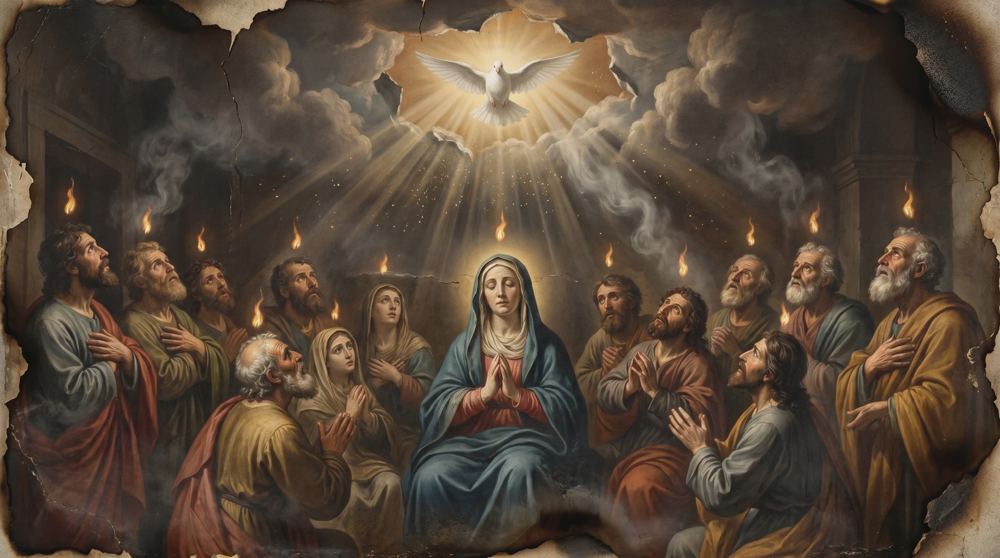
Pentecost is the feast, kept fifty days after Easter, of the descent of the Holy Ghost upon the Apostles and the Blessed Virgin gathered in the upper room at Jerusalem. On that day the Third Person of the Holy Trinity came down in tongues of fire, and the Church was sent out to all nations — which is why we call Pentecost the birthday of the Church.
What is Pentecost?
The word Pentecost means "the fiftieth," for the feast falls on the fiftieth day reckoned from Easter Sunday, the seventh Sunday after the Resurrection. It is the close and crown of the whole paschal cycle that opens with the season of Lent and runs through Easter and the Ascension of Our Lord to this fiftieth day. As Dom Guéranger writes, "the days of Pentecost are accomplished. Seven weeks have passed since the Pasch, and now comes the day that opens the mysterious number of fifty." Already this Sunday had been made holy by the creation of light and by the rising of Our Lord from the tomb; on this day it "receives its final consecration and brings us the fullness of God."
The feast has an older root that Christ fulfils. Among the Jews, the fiftieth day after the Pasch was the harvest feast and the day commemorating the giving of the Law on Sinai. Guéranger draws the parallel exactly: "As of old Israel, having passed the Red Sea by the power of the Paschal Lamb, received on the fiftieth day the alliance of God upon Sinai, so now, fifty days after the true Pasch, the Holy Ghost comes down to seal the New Covenant and give the Church her birth." The Law once written on stone is now written by the Spirit on the hearts of the faithful.
The feast of Pentecost: the descent of the Holy Ghost
The event itself is set down in the Acts of the Apostles. The Apostles, with Mary the Mother of Jesus, were gathered together in prayer when "suddenly there came a sound from heaven, as of a mighty wind coming, and it filled the whole house where they were sitting. And there appeared to them parted tongues as it were of fire, and it sat upon every one of them: and they were all filled with the Holy Ghost." Cardinal Schuster summarises the day plainly: "the Lord sends forth the Holy Ghost, as He had promised... the Holy Ghost appeared to the apostles gathered in the upper room."
This is no created force or mere influence. The Catechism of the Council of Trent teaches that "the Holy Ghost is God, like the Father and the Son... equal to them in all things, Almighty like them, eternal like them," and that He "proceedeth from the Father and the Son" as from a single principle. The Comforter whom Our Lord promised at the Supper — "the Spirit of truth who proceedeth from the Father, and who shall give testimony of Me" — is the very God who now takes possession of the Apostles and makes them witnesses to the ends of the earth. To know who this Person is within the one Godhead, see the Holy Trinity.
The birthday of the Church
Before Pentecost the Apostles were timid men hidden behind closed doors. After it they went out and preached Christ crucified and risen to a crowd drawn from every nation under heaven, and three thousand were baptised in a single day. This is why the Fathers call Pentecost the birthday of the Church: on this day she was sent forth to all peoples. As Dom Pius Parsch writes, "the Holy Ghost came down in fiery tongues upon the apostles gathered in Jerusalem, and the Church was sent forth to all nations... the spiritual harvest of souls is ready to be reaped by the apostles."
Our Lady stands at the centre of this scene. She who had conceived the Son by the overshadowing of the same Spirit is now enthroned in the midst of the Apostles as Queen of the Apostles, "the prototype of the praying Church of every age." The Church is born around her, in prayer, waiting upon the gift from on high.
The link between Pentecost and Baptism is ancient and deliberate. Schuster notes that "the Latin Church solemnly administers baptism on the Eve of Pentecost as on Easter Eve," for the water of grace is itself a figure of the Spirit. By Baptism we are made temples of the Holy Ghost; the Apostle asks, "Know you not that your members are the temples of the Holy Ghost?" The same Spirit who descended visibly upon the Apostles descends invisibly upon every soul reborn in the font.
The gifts of the Holy Ghost
When the Holy Ghost dwells in a soul, He does not come empty-handed. The Catechism of Trent enumerates, after the prophet Isaias, the sevenfold endowment "commonly named the Gifts of the Holy Ghost": "the Spirit of Wisdom and of understanding, the Spirit of Counsel and of Fortitude, the Spirit of Knowledge and of Piety, the Spirit of the fear of the Lord." These gifts, the Catechism says, "are for us as a divine source whence we draw the precepts of the Christian Life, and by them again we can know whether the Holy Ghost truly dwells in us."
Above all these gifts stands one grace. Trent teaches that the first of the Holy Ghost's effects "must take precedence of all the others, is the Grace which justifies us... which attaches us to God by the closest bonds of love, which kindles in our hearts the ardent zeal of piety, which makes us undertake a new life, which renders us partakers of the divine nature, and makes us merit the name and the real quality of children of God." The fire seen upon the Apostles is the visible sign of this inner fire of charity poured into the heart. We treat these gifts at greater length in the gifts of the Holy Ghost.
Schuster captures the double character of this fire: the Church in the Postcommunion of the Mass "begs that the Holy Spirit may purify our hearts by the flames of His love — flames whose fierceness the Paraclete tempers with the cool, refreshing dew of His consolations." The same Spirit who burns away sin also refreshes and consoles. This is why the Church sings the Veni Creator at every great outpouring of grace — at ordinations, at the consecration of churches, at the opening of councils — calling down the Creator Spirit upon her members.
What is Jewish Pentecost?
Many ask what the Jewish Pentecost is and how it differs from the Christian feast. The Jewish feast — called in Hebrew Shavuoth, the "Feast of Weeks" — was kept on the fiftieth day after the Pasch and had a double character. It was first a harvest festival, on which the firstfruits of the wheat were offered in the Temple; it later became the day commemorating the giving of the Law to Moses on Mount Sinai. This is the feast that had drawn devout Jews "out of every nation under heaven" to Jerusalem on the very day the Holy Ghost descended (Acts 2:5). The Christian Pentecost does not abolish but fulfils it: as the firstfruits of the harvest were once brought to the Temple, so now the firstfruits of souls — three thousand baptised in a day — are gathered into the Church; and as the Law was once given on stone, so now the Spirit writes the new law of charity on the heart. The Jewish holiday is the figure; the descent of the Holy Ghost is the reality.
What day is Pentecost? (2025, 2026, and how it is reckoned)
Pentecost has no fixed calendar date, because it is reckoned from Easter, which is movable. The rule is simple: count fifty days from Easter Sunday inclusive, which always lands Pentecost on the seventh Sunday after the Resurrection. In 2025 Pentecost Sunday falls on 8 June; in 2026 it falls on 24 May. Because the date moves with Easter, the surest way to find it in any year is to locate Easter and count seven Sundays onward. The traditional calendar keeps the same reckoning for the Roman rite, so the Pentecost of the 1962 books falls on the same Sunday.
What is Pentecost Monday?
Pentecost Monday — Whit Monday — is the day immediately following Pentecost Sunday. In the older Roman calendar it was the second day within the Octave of Pentecost, kept with its own Mass and a Gospel reading ("God so loved the world..."), and in many Catholic countries it remained a holiday of obligation or a civil holiday long after. In the reform of 1969 the Octave of Pentecost was suppressed in the new calendar, so that in the modern Roman rite the season "Ordinary Time" resumes on the Monday; this is one of the changes the traditional calendar does not follow, where the ancient Octave is still observed. We note this plainly: the suppression of the Octave is a post-1958 alteration, not the immemorial practice of the Latin Church.
Is "Pentecost" a church or denomination?
A frequent confusion is between Pentecost as a feast and "Pentecostal" churches as a denomination. They are not the same thing. Pentecost is a feast of the universal Church, kept by Catholics since apostolic times, commemorating an event recorded in the Acts of the Apostles. "Pentecostalism," by contrast, is a movement that arose only in the early twentieth century among certain Protestant groups, taking its name from the same event but constituting a distinct body separated from the Catholic Church. When Catholics speak of "Pentecost" we mean the feast of the Holy Ghost's descent — the birthday of the one Church founded by Christ upon the Apostles — not a denomination.
A prayer for Pentecost
The Church's own prayer for Pentecost is the hymn Veni, Sancte Spiritus, the Golden Sequence sung at the Mass of the day. Its opening verses make a fitting prayer for the feast:
Come, Holy Ghost, send down those beams,
which sweetly flow in silent streams
from Thy bright throne above.
O come, Thou Father of the poor;
O come, Thou source of all our store,
come, fill our hearts with love.
O Thou, of comforters the best,
O Thou, the soul's delightful guest,
the pilgrim's sweet relief.
To this the Church adds the ancient versicle and prayer: "Send forth Thy Spirit, and they shall be created; and Thou shalt renew the face of the earth. O God, who hast taught the hearts of the faithful by the light of the Holy Ghost, grant us in the same Spirit to be truly wise, and ever to rejoice in His consolation. Through Christ our Lord. Amen." The great hymn of invocation, the Veni Creator, serves the same purpose whenever we call down the Spirit.
Whitsunday and the octave
In the English-speaking world the feast of Pentecost has long borne the name Whitsunday, that is, "White Sunday," from the white garments worn by those newly baptised at the vigil. The feast is of the first rank in the calendar, kept with its own vigil and formerly with a full octave, and it gives its name to the long stretch of Sundays that follow, the Sundays after Pentecost, which carry the Church through to Advent. To see where Pentecost stands within the whole cycle of feasts, see the liturgical year.
Frequently Asked Questions
What is Pentecost?
Pentecost is the feast, kept fifty days after Easter, of the descent of the Holy Ghost upon the Apostles and the Blessed Virgin gathered in the upper room at Jerusalem. On that day the Third Person of the Holy Trinity came down in tongues of fire, and the Church was sent out to all nations — which is why the Fathers call Pentecost the birthday of the Church.
What is Pentecost Sunday?
Pentecost Sunday is the seventh Sunday after Easter, the fiftieth day of the paschal cycle, on which the Church keeps the feast of the coming of the Holy Ghost. It is a feast of the first rank, with its own vigil and formerly a full octave, and it gives its name to the long season of Sundays after Pentecost that carries the Church through to Advent.
What is Pentecost in the Bible?
In the Bible, Pentecost is recorded in the Acts of the Apostles: the disciples, gathered with Mary, heard "a sound from heaven, as of a mighty wind," and there appeared "parted tongues as it were of fire," and "they were all filled with the Holy Ghost" (Acts 2:2-4, Douay-Rheims). The name comes from the Greek for "the fiftieth," and it fulfils the older Jewish harvest feast kept on the fiftieth day after the Pasch, which commemorated the giving of the Law on Sinai.
What is the meaning of Pentecost?
The word Pentecost means "the fiftieth," for the feast falls on the fiftieth day counted from Easter Sunday. Its meaning is the sending of the Holy Ghost and the birth of the Church: as Israel received the Law on Sinai fifty days after the first Pasch, so the Church receives the Spirit fifty days after the true Pasch, and the Law once written on stone is now written on the hearts of the faithful.
What day is Pentecost in 2025 and 2026?
Pentecost is movable, reckoned as the fiftieth day from Easter, which is the seventh Sunday after Easter Sunday. In 2025 Pentecost Sunday falls on 8 June; in 2026 it falls on 24 May. To find it in any year, locate Easter and count seven Sundays onward.
What is Pentecost in the Catholic Church?
In the Catholic Church, Pentecost is a feast of the first rank commemorating the descent of the Holy Ghost upon the Apostles and Our Lady, fifty days after Easter — the day the Church was sent out to all nations. Catholics keep it with the Veni Creator and the Golden Sequence Veni Sancte Spiritus, and in the traditional calendar with a vigil and a full octave including Whit Monday.
What is Pentecost Monday?
Pentecost Monday, or Whit Monday, is the day after Pentecost Sunday. In the traditional Roman calendar it was the second day within the Octave of Pentecost, with its own Mass; the octave was suppressed in the post-1958 reform of 1969, but the traditional calendar still observes it.
What is Jewish Pentecost?
Jewish Pentecost is the Feast of Weeks (Shavuoth), kept on the fiftieth day after the Pasch as a harvest festival and as the commemoration of the giving of the Law on Sinai. The Christian Pentecost fulfils it: the firstfruits of souls are gathered into the Church, and the Spirit writes the new law of charity on the heart.
What is Whitsunday?
Whitsunday is the old English name for the feast of Pentecost, meaning "White Sunday," from the white garments worn by those newly baptised at the vigil. It names the same feast — the descent of the Holy Ghost fifty days after Easter — and gives its name to "Whitsuntide," the days that follow.
Pentecost is the seal of Easter. The Father gave the Son; the Son, returning to the Father, gave the Holy Ghost; and the Holy Ghost gives Himself, that we who were strangers might be made temples of God and heirs of life everlasting. The fire that fell once upon the upper room has never gone out, for it is the life of the Church.
The Iter Fidei app carries the prayers, the traditional calendar of feasts, and the catechism — the Veni Creator and the propers of Pentecost among them. Download it here.
Sources. Catechism of the Council of Trent (1566), Eighth Article of the Creed, "I believe in the Holy Ghost." Dom Prosper Guéranger, The Liturgical Year, Pentecost Sunday. Cardinal Ildefonso Schuster, The Sacramentary (Liber Sacramentorum), Pentecost. Dom Pius Parsch, The Church's Year of Grace, Pentecost. Acts of the Apostles 2 (Douay-Rheims). Isaias 11 (Douay-Rheims). 1 Corinthians 6 (Douay-Rheims).