
Prayer
The Veni Creator Spiritus
The Veni Creator Spiritus — 'Come, Holy Ghost, Creator blest' — is the Church's great hymn to the Holy Ghost, sung at Pentecost, confirmations, and ordinations. Full text in English and Latin, with its meaning.
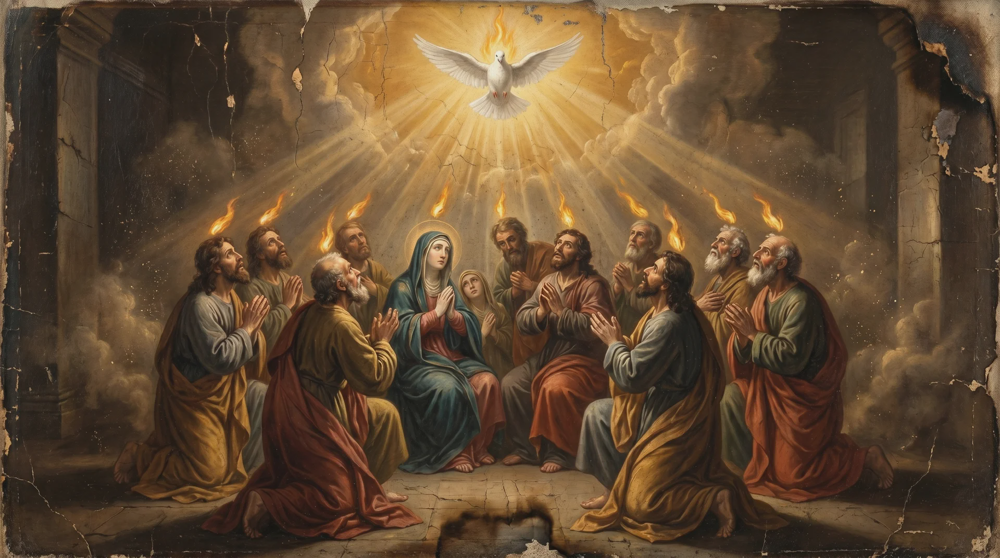
The Veni Creator Spiritus — Latin for Come, Creator Spirit — is the Church's great hymn to the Holy Ghost, an invocation that calls down the Third Person of the Blessed Trinity and His sevenfold gifts upon the soul. In English it begins "Come, Holy Ghost, Creator blest." The Church sings it at Pentecost, at confirmations, at ordinations, at the opening of councils and conclaves, and whenever a grave work is begun under the light of God. We here give the Veni Creator in English and in its traditional Latin form, and explain what it means and when to pray it.
The Veni Creator in English
Come, Holy Ghost, Creator blest,
And in our hearts take up Thy rest;
Come with Thy grace and heavenly aid,
To fill the hearts which Thou hast made.O Comforter, to Thee we cry,
Thou heavenly gift of God most high,
Thou Fount of life, and Fire of love,
And sweet anointing from above.Thou in Thy sevenfold gifts art known;
Thou finger of God's hand we own;
Thou, promise of the Father, Thou
Who dost the tongue with power imbue.Kindle our senses from above,
And make our hearts o'erflow with love;
With patience firm and virtue high
The weakness of our flesh supply.Far from us drive the foe we dread,
And grant us Thy true peace instead;
So shall we not, with Thee for guide,
Turn from the path of life aside.Oh, may Thy grace on us bestow
The Father and the Son to know,
And Thee, through endless times confessed,
Of both the eternal Spirit blest.All glory while the ages run
Be to the Father and the Son
Who rose from death; the same to Thee,
O Holy Ghost, eternally. Amen.
The Veni Creator in Latin
Veni, Creator Spiritus,
Mentes tuorum visita,
Imple superna gratia,
Quae tu creasti pectora.Qui diceris Paraclitus,
Altissimi donum Dei,
Fons vivus, ignis, caritas,
Et spiritalis unctio.Tu septiformis munere,
Digitus paternae dexterae,
Tu rite promissum Patris,
Sermone ditans guttura.Accende lumen sensibus,
Infunde amorem cordibus,
Infirma nostri corporis
Virtute firmans perpeti.Hostem repellas longius,
Pacemque dones protinus;
Ductore sic te praevio
Vitemus omne noxium.Per te sciamus da Patrem,
Noscamus atque Filium,
Teque utriusque Spiritum
Credamus omni tempore.Deo Patri sit gloria,
Et Filio, qui a mortuis
Surrexit, ac Paraclito,
In saeculorum saecula. Amen.
The Veni Creator Spiritus hymn: its chant and author
The Veni Creator is not only a prayer to be read but a hymn to be sung, and it has been sung in the Roman rite for more than a thousand years. It is most often attributed to Rabanus Maurus (c. 780–856), the Benedictine abbot of Fulda and later Archbishop of Mainz, and it entered the liturgy as the hymn of the Office at Pentecost. From there it spread to every solemn invocation of the Holy Ghost in the Latin Church.
Its proper Gregorian melody is one of the most familiar in the whole chant repertory — a strong, rising line in the eighth mode that any congregation can carry. In the traditional books the hymn is given two forms: the plain syllabic chant for ordinary use, and a more solemn melody for the great occasions. When you see the title written as veni veni creator spiritus, this is usually the memory of the sung incipit, where the first word is drawn out and seems to be repeated; the text itself begins with a single Veni. The hymn is also frequently set in polyphony and in the chorale tradition, but its native voice is the Gregorian chant, and it is in that form that the Church has always loved it best.
To learn the hymn, the surest way is to sing the first verse — Veni, Creator Spiritus — until the melody is fixed in the ear, for every following verse is sung to the same tune. Once the first stanza is known, the whole hymn is known.
A note on the title: Veni Creator Spiritus, Veni Spiritus Creator
The hymn is correctly titled Veni, Creator Spiritus — "Come, Creator Spirit." The order of the words matters: Creator qualifies Spiritus, so the line addresses the Spirit who is Creator. The variant spelling veni spiritus creator names the same hymn and the same Holy Ghost; only the Latin word order is inverted, and the traditional and liturgical form is always Veni, Creator Spiritus. The doubled form veni veni creator spiritus is not a different prayer either, but the sung first line as it is often remembered. Whatever the spelling searched, there is one hymn, the great Pentecost hymn to the Holy Ghost given above.
What the Veni Creator means
The hymn is, line by line, a profession of faith in the Holy Ghost. It does not merely ask Him to come; it confesses who He is. The Church teaches that the Holy Ghost is "the third Person of the Most Holy Trinity, that He is God eternal, infinite, almighty, the Creator and Lord of all things, like the Father and the Son" (Catechism of St Pius X, First Part, Eighth Article). So the hymn rightly names Him Creator and addresses Him as God.
The opening verses gather up the Spirit's proper titles. We call Him Paraclitus — the Comforter — and donum Dei, the gift of God most high. He is rightly called gift, Trent explains, "for one calls gift that which is granted liberally, gratuitously, and without hope of recompense" (Roman Catechism, Eighth Article, §III). He is named Fons vivus, the living Fount of life, and ignis, caritas — Fire and Love — because His procession and His proper work are of love: "The Holy Ghost proceeds from the Father and the Son as from a single principle by way of will and love," and "the work attributed especially to the Holy Ghost is the sanctification of souls" (Catechism of St Pius X, Eighth Article). The spiritalis unctio, the spiritual anointing, points to the very oil of the sacrament of Confirmation, in which the Holy Ghost is given.
The third verse is the heart of the hymn: Tu septiformis munere — Thou who art sevenfold in gift. This is the line our English renders "Thou in Thy sevenfold gifts art known." The Church counts seven gifts of the Holy Ghost: "Wisdom, Understanding, Counsel, Fortitude, Knowledge, Piety, and the Fear of God" (Catechism of St Pius X, Fifth Part). Trent draws the same sevenfold list from the prophet Isaias, who names the Spirit "of Wisdom and of understanding, the Spirit of Counsel and of Fortitude, the Spirit of Knowledge and of Piety, the Spirit of the fear of the Lord" (Roman Catechism, Eighth Article, §III; Isaias xi). These gifts, the catechism teaches, "serve to confirm us in Faith, Hope, and Charity; and to make us prompt in the acts of virtue necessary to acquire the Christian life." To sing Veni Creator is therefore to ask for these seven gifts by name.
The same verse calls the Spirit digitus paternae dexterae, the finger of God's right hand, and promissum Patris, the promise of the Father — He whom Christ pledged to send. The hymn then recalls Pentecost in sermone ditans guttura, "Who dost the tongue with power imbue": the Holy Ghost "descended upon the Apostles on the day of Pentecost," and there "filled them with light, strength, charity, and the abundance of all His gifts" (Catechism of St Pius X, Eighth Article).
The middle verses turn to petition: kindle the senses, pour love into our hearts, strengthen the weakness of the flesh, drive far the enemy, and grant true peace, that with the Spirit as our guide (ductore sic te praevio) we may shun all that is hurtful. The closing verses lift the hymn back to the whole Trinity. We ask through the Spirit to know the Father and the Son — for it is by the Holy Ghost that we confess the Holy Trinity — and we end, as the Church always ends, with the doxology of glory to Father, Son, and Holy Ghost.
When to pray it
The Veni Creator belongs first to Pentecost, when the Church keeps the descent of the Holy Ghost upon the Apostles. It is sung at the great moments when His grace is invoked for a sacred work: at confirmations, when the bishop confers the Spirit and His seven gifts; at ordinations, when men are made priests; at the consecration of bishops; at the opening of synods, councils, and conclaves; at the beginning of the liturgical year and of a new work of the Church.
It is no less fitting in private. The Church grants an indulgence to the faithful who recite the Veni Creator. We may pray it at the start of any serious undertaking — a study, a journey, a decision, an examination of conscience — to place the work under the light and strength of the Holy Ghost. It is fitting too on a birthday, at the threshold of a new year of life, alongside the traditional birthday prayers and blessings of the Church. To sing or say it is to do what the Apostles did in the Cenacle, where, with the Blessed Virgin, "they persevered in prayer, awaiting the Holy Ghost whom Jesus Christ had promised them" (Catechism of St Pius X, Eighth Article).
A printable Veni Creator (text to copy or save as PDF)
Many who pray the Veni Creator wish to keep the full text to hand — to print it, to save it as a PDF, or to carry it in a missal. The complete hymn, in English and in Latin, is given in full above; both the English translation and the Latin original may be copied freely for private devotion. To make your own printable sheet, copy the two blocks above into a document and save or print it; the text is short enough to fit on a single page in either language. The traditional Latin and the standard English rendering ("Come, Holy Ghost, Creator blest") are the forms we have given, so that what you print is exactly what the Church sings.
The Iter Fidei app also carries the Veni Creator with you, in Latin and in your own language, with the chant to pray along — so you need not print anything at all.
Frequently Asked Questions
What does Veni Creator Spiritus mean?
Veni Creator Spiritus is Latin for "Come, Creator Spirit" — the opening invocation of the hymn, by which the Church calls down the Holy Ghost, the Third Person of the Blessed Trinity, upon the soul. In English it begins "Come, Holy Ghost, Creator blest." The title names exactly what the prayer does: it asks the Spirit who is Himself God and Creator to come and take up His rest in the hearts He has made.
When is the Veni Creator prayed?
The Veni Creator belongs first to Pentecost, the feast of the descent of the Holy Ghost upon the Apostles. It is sung at the great moments when His grace is invoked for a sacred work: at confirmations, at ordinations, at the consecration of bishops, at the opening of synods, councils, and conclaves, and at the beginning of the liturgical year. It is no less fitting in private, at the start of any serious undertaking — a study, a journey, a decision — to place the work under the light of the Holy Ghost.
Is there an indulgence for the Veni Creator?
Yes. The Church has long granted an indulgence to the faithful who devoutly recite the Veni Creator, and a plenary indulgence, under the usual conditions, to those who sing or recite it on the first of January and on the feast of Pentecost. To pray it is therefore both an act of devotion to the Holy Ghost and a means of grace the Church herself commends.
What are the seven gifts named in the Veni Creator?
The hymn's central verse, Tu septiformis munere — "Thou in Thy sevenfold gifts art known" — invokes the seven gifts of the Holy Ghost: Wisdom, Understanding, Counsel, Fortitude, Knowledge, Piety, and the Fear of God. The Church draws this sevenfold list from the prophet Isaias (Isaias xi, 2–3). To sing the Veni Creator is, in effect, to ask the Holy Ghost for these seven gifts by name.
Who wrote the Veni Creator Spiritus?
The hymn is traditionally attributed to Rabanus Maurus (c. 780–856), a Benedictine monk who became abbot of Fulda and Archbishop of Mainz. It was already established as the hymn of the Holy Ghost in the medieval Roman Office and has been sung at Pentecost, confirmations, ordinations, and conclaves ever since. Its proper Gregorian melody, in the eighth mode, is among the best known in the chant repertory.
Why is it sometimes written "veni veni creator spiritus"?
The hymn's true first line is Veni, Creator Spiritus — with a single Veni ("Come"). The doubled form, veni veni creator spiritus, is not a different prayer; it usually reflects how the sung incipit is remembered, where the opening word is drawn out in the chant. The text given here, beginning "Come, Holy Ghost, Creator blest," is the complete and correct hymn.
Is the Veni Creator a prayer or a hymn?
It is both. The Veni Creator is a hymn — verse meant to be sung to its Gregorian melody — and it is at the same time a true prayer, an invocation of the Holy Ghost that may be recited devoutly without music. The Church uses it in both ways: chanted at Pentecost and at solemn occasions, and recited privately at the start of any serious work. Whether sung or said, it asks the same thing: that the Holy Ghost come and dwell in the soul with His sevenfold gifts.
The Veni Creator asks for nothing less than God Himself, the Spirit of love, to take up His rest in the hearts He has made. We ask it because we cannot sanctify ourselves: every grace we have, we have received from the liberality of the Holy Ghost.
The Iter Fidei app serves this prayer in Latin and in your own language, with audio to pray along. Download it here.
Sources. Catechism of St Pius X, First Part, Eighth and Ninth Articles (the Holy Ghost; the Church), Fourth Part, ch. 3 (Confirmation), Fifth Part, ch. 2 (the Gifts of the Holy Ghost); Catechism of the Council of Trent (Roman Catechism), Eighth Article of the Creed, "I Believe in the Holy Ghost," §§ I–III; Isaias xi, 2–3.