
Devotions
What Is a Chaplet? The Traditional Chaplets of the Church
What a chaplet is — a counted set of prayers told on beads, distinct from the full Rosary — its place in Catholic tradition, and the principal traditional chaplets: St Michael, the Seven Sorrows, the Holy Face, the Five Wounds, the Sacred Heart.
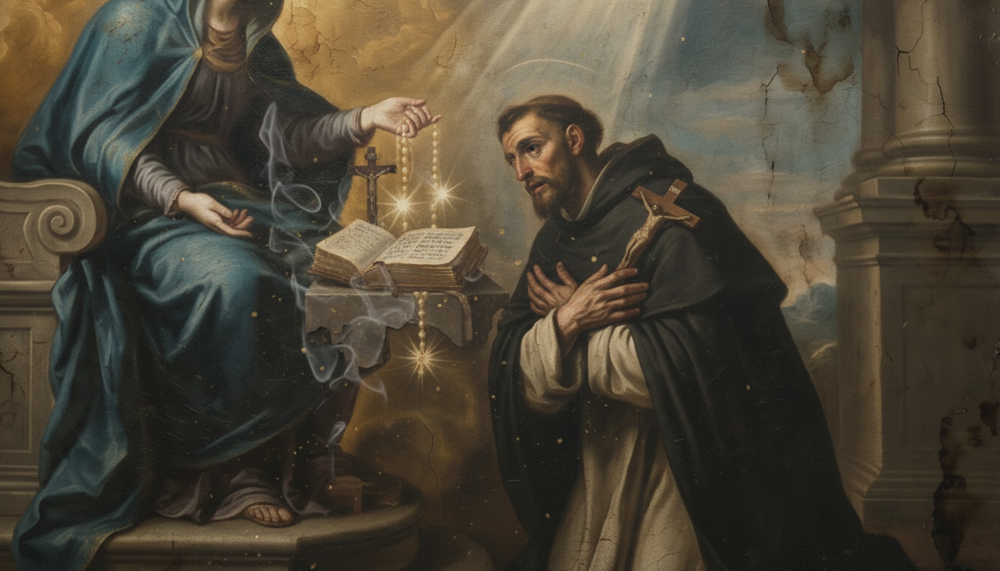
A chaplet is a counted set of prayers told on a string of beads, by which the faithful repeat a fixed cycle of vocal prayers in honour of Our Lord, His Mother, or a saint. In its strict chaplet meaning it is distinct from the full Rosary — the great Marian devotion of fifteen decades, one hundred and fifty Hail Marys answering the one hundred and fifty psalms — though the two are close kin and the words are often used loosely. Catholic chaplets are smaller, varied forms of the same kind of prayer: vocal prayer made with the attention of the mind, told on beads, in honour of a particular mystery or patron.
What a chaplet is
The Church divides prayer into mental and vocal: mental prayer is made with the mind alone; vocal prayer is made with words accompanied by the attention of the mind to what we say and to Him to whom we speak (Catechism of St Pius X, On Prayer in General). A chaplet belongs to vocal prayer of the settled, repeated kind. Its proper notes are three: it is counted — the beads keep the number so the mind is free to pray rather than to reckon; it is fixed — a known set of prayers in a known order, learned once and prayed without a book; and it is honorific — directed to a particular object, a mystery of the faith or the intercession of a saint, in whose honour the prayers are offered.
The bead-string itself is a sacramental, a blessed object the Church has enriched with indulgences for the prayers told on it. The beads are not a charm. Their whole power is the prayer of the Church and the devotion of the one who uses them with faith. What sanctifies is not the wood or the metal but the prayer that passes through the fingers — the raising of the mind to God to adore Him, to thank Him, and to ask of Him what we need (Catechism of St Pius X, On Prayer in General). For the broader place of beads and blessed objects in the life of piety, see our guide to Catholic devotions.
Chaplet and Rosary — the distinction
The confusion is old and harmless, but worth setting straight. The Rosary is the Marian psalter: fifteen decades — joyful, sorrowful, and glorious mysteries — each decade an Our Father, ten Hail Marys, and a Glory be, prayed while meditating on the life, death, and glory of Christ and His Mother. The Catechism counts it among the practices of piety the Christian ought, if he can, to perform each day (Catechism of St Pius X, On the Pious Exercises Counselled to the Christian). If you are learning it, begin with how to pray the Rosary.
A chaplet, by contrast, is any of the smaller counted devotions: a shorter or differently-shaped string, a different set of prayers, a different patron. Every Rosary is in the wide sense a chaplet, but not every chaplet is the Rosary. The word "chaplet" once meant simply a little crown or garland — a wreath of prayers offered to God or to a saint — and that older sense still governs. Where the Rosary crowns Our Lady with roses, the other chaplets weave their own garlands: to St Michael, to the Sorrows of Mary, to the Holy Face, to the Wounds and the Heart of Our Lord. They draw their power from the same prayers, the Pater and the Ave, which the Church set at the head of all vocal prayer (Catechism of St Pius X, On the Our Father; On the Hail Mary).
What is a chaplet prayer?
A chaplet prayer is the vocal prayer itself — the fixed set of words told on the beads, as distinct from the bead-string that counts it. The phrase covers two things at once: the form (a repeated cycle of short prayers, said in a known order) and the intention (the mystery or saint in whose honour they are offered). Most chaplet prayers are built from the prayers the Church set at the head of all vocal prayer — the Pater noster (Our Father) and the Ave Maria (Hail Mary) — joined to a proper invocation peculiar to each devotion (Catechism of St Pius X, On the Our Father; On the Hail Mary).
So the Chaplet of St Michael adds its nine angelic salutations; the Seven Sorrows adds the meditation on Our Lady's dolours; the Five Wounds adds the veneration of each Wound of the Crucified. What makes a string of prayers a chaplet prayer rather than loose devotion is that it is counted, fixed, and honorific — the three notes named above. A chaplet prayer is therefore not improvised; it is learned once and prayed by heart, the beads leaving the mind free to dwell on the mystery rather than to keep the tally.
What is a chaplet rosary?
People often ask what a "chaplet rosary" is, because the two devotions share the same beads and the same root prayers. The plain answer: a chaplet rosary is simply a chaplet told on rosary-style beads — a counted cord or loop of beads used to number the prayers of a devotion shorter or different from the fifteen-decade Rosary itself.
The word rosary first meant a "rose garden" or a garland of roses offered to Our Lady, and chaplet meant a little crown or wreath; both names belong to the same family of bead-prayer. In ordinary speech, then:
- A Rosary (with a capital R) is the great Marian devotion of fifteen decades — one hundred and fifty Hail Marys answering the one hundred and fifty psalms, with the joyful, sorrowful, and glorious mysteries.
- A chaplet rosary is any of the smaller bead-devotions: a shorter loop, a different count, a different patron — the St Michael chaplet, the Seven Sorrows, the Holy Face, and so on.
The beads of a chaplet may be many or few. Some chaplets, like the Divine Mercy, are even told on an ordinary five-decade Rosary; others have their own proper string — the Seven Sorrows with its seven groups, the St Michael chaplet with its nine. The bead-string in every case is a sacramental, blessed and indulgenced by the Church for the prayers told on it; the beads themselves are no charm, and their whole power is the prayer of the Church and the faith of the one who prays it.
The traditional Catholic chaplets
Among the many forms, a handful stand out as the proven, traditional chaplets — devotions formed before 1958, indulgenced by the pre-Conciliar Church, and grounded in the great mysteries of the faith.
The Chaplet of St Michael
The Chaplet of St Michael the Archangel honours the great Archangel and the nine choirs of angels. Through nine salutations — one for each choir, from the Seraphim to the Angels — it asks, by St Michael's intercession, for the gifts proper to each rank of the heavenly host, each salutation followed by an Our Father and three Hail Marys, and closed by four Our Fathers in honour of St Michael, St Gabriel, St Raphael, and the Guardian Angel. The devotion was indulgenced by Pope Pius IX in 1851. It is the chaplet of spiritual warfare, well prayed on Michaelmas and against the malice of the devil.
The Seven Sorrows (Servite) chaplet
The Seven Sorrows chaplet, also called the Servite Rosary, meditates the seven great sorrows of Our Lady — from the prophecy of Simeon to the burial of her Son. On seven groups of beads, an Our Father and seven Hail Marys are prayed at each sorrow, joining the soul to the Mother who stood beneath the Cross. It is the proper devotion of the Servite Order, of long standing in the Church and enriched with indulgences, and it belongs especially to the feast of the Seven Dolours and to the Fridays of Lent.
The Holy Face chaplet
The Holy Face chaplet honours the adorable Face of Our Lord, disfigured in His Passion, and offers reparation for blasphemy and the profanation of the holy days. Told on a string ordered to the senses of the Sacred Face and the words of the Gloria Patri, it grew from the reparation devotion fostered in the nineteenth century and approved before the Council. It is the chaplet of reparation, a making-amends for the outrages done to the Name and the Face of God.
The Five Wounds chaplet
The chaplet of the Five Wounds honours the five sacred Wounds of the Crucified — the wounds in the hands, the feet, and the side. On its beads the soul venerates each Wound in turn, often with five Our Fathers and a Hail Mary, pleading the Precious Blood that flowed from them for the living and the dead. It is among the oldest forms of devotion to the Passion, kept by the faithful long before the modern chaplets, and it draws the soul into the wounds where, as the Fathers say, the dove of the soul finds her nest.
The Sacred Heart chaplet
The chaplets of the Sacred Heart of Jesus honour the Heart of Our Lord as the symbol and the source of His love for men, and answer that love with acts of reparation for the sins by which it is outraged. Several traditional forms exist — see the Chaplet of the Sacred Heart — counted invocations and ejaculatory prayers told on beads, often closing with one of these:
Sweet Heart of Jesus, be my love.
Sacred Heart of Jesus, I place my trust in Thee.
They are the bead-form of the great devotion that gave the Church the First Fridays and the Litany of the Sacred Heart, and they belong to June and to every First Friday.
The Precious Blood chaplet
The Chaplet of the Precious Blood honours the seven sheddings of the Blood of Our Lord, from the Circumcision to the wound of the lance, told on thirty-three Our Fathers for the thirty-three years of His earthly life. Spread by St Gaspar del Bufalo and indulgenced by Pope Pius IX, who gave the whole Church the feast of the Most Precious Blood, it is the chaplet of the price of our redemption, and the whole of July is dedicated to it.
The Chaplet of the Holy Ghost
The Chaplet of the Holy Ghost honours the Third Person of the Blessed Trinity by invoking, one by one, the Seven Gifts He pours into the soul — Wisdom, Understanding, Counsel, Fortitude, Knowledge, Piety, and the Fear of God. Opening with the Veni Creator, it asks the Holy Ghost to stir into flame the gifts received in Baptism and sealed in Confirmation. It belongs especially to the great novena between the Ascension and Pentecost.
A note on the modern chaplets
Not every chaplet in circulation is ancient. Some are devotions of the twentieth century, formed after the period to which we hold. The best known are the Divine Mercy chaplet and, of older root but lately the most prayed, the Chaplet of St Michael. We do not tell the reader's beads for him, and we make no quarrel with those who pray them; but our own home is the older tradition, and the prayers we set before you are those the Church had proved and indulgenced before 1958.
What is the Divine Mercy chaplet?
The Divine Mercy chaplet is a counted devotion told on ordinary Rosary beads, asking the mercy of God upon the world through the Passion of His Son. It arose from the private revelations recorded by St Faustina Kowalska in the 1930s and was promoted only in the decades that followed — which is why it falls outside the pre-1958 measure we keep here. On a Rosary it is prayed thus: begin with an Our Father, a Hail Mary, and the Apostles' Creed; then on each large bead say:
Eternal Father, I offer Thee the Body and Blood, Soul and Divinity of Thy dearly beloved Son, Our Lord Jesus Christ, in atonement for our sins and those of the whole world.
And on each of the ten small beads:
For the sake of His sorrowful Passion, have mercy on us and on the whole world.
Closing three times with:
Holy God, Holy Mighty One, Holy Immortal One, have mercy on us and on the whole world.
We make no quarrel with those who pray it, and the same hunger for mercy it answers is met more surely, we hold, by the older devotions of the Passion and the Heart — the Holy Face chaplet, the Five Wounds, and the Chaplet of the Precious Blood. For why we hold to the traditional measure, see our fuller treatment of the Divine Mercy chaplet.
The reader who wants the surest ground will find it in the chaplets above — above all the proven Chaplet of St Michael for spiritual warfare — and in the wider body of Catholic prayers the Church has kept from the beginning.
Which chaplet, and when
There is no obligation to pray a chaplet, and no virtue in praying many badly. A few told well — with recollection, humility, and confidence, the dispositions the Catechism requires of all prayer (Catechism of St Pius X, On Prayer in General) — do more for a soul than a drawer full of beads said in haste. Choose by need and by season: the Chaplet of St Michael when you seek the protection of the angels; the Seven Sorrows in Lent and at the foot of the Cross; the Holy Face and the Five Wounds in reparation for sin; the Sacred Heart in June and on the First Fridays. Let the chaplet feed the mental prayer it is meant to carry, and it becomes what the Church intends — a little crown of vocal prayer that raises the mind to God.
Frequently Asked Questions
What is a chaplet?
A chaplet is a counted set of prayers told on a string of beads, by which the faithful repeat a fixed cycle of vocal prayers in honour of Our Lord, His Mother, or a saint. Its proper notes are three: it is counted (the beads keep the number so the mind is free to pray), fixed (a known set of prayers in a known order), and honorific (directed to a particular mystery or patron). In its strict sense a chaplet is distinct from the full Rosary, though every Rosary is, broadly, a chaplet.
What is the difference between a chaplet and the Rosary?
The Rosary is the great Marian psalter — fifteen decades, one hundred and fifty Hail Marys answering the one hundred and fifty psalms, with the joyful, sorrowful, and glorious mysteries. A chaplet is any of the smaller counted devotions: a shorter or differently-shaped string, a different set of prayers, a different patron. Every Rosary is in the wide sense a chaplet, but not every chaplet is the Rosary.
What is a chaplet prayer?
A chaplet prayer is the vocal prayer told on the beads — the fixed cycle of words said in a known order, as distinct from the bead-string that counts it. Most chaplet prayers are built from the Our Father and the Hail Mary, the prayers the Church set at the head of all vocal prayer, joined to a proper invocation peculiar to each devotion. It is counted, fixed, and honorific: learned once and prayed by heart, so the mind is free to dwell on the mystery rather than to keep the tally.
What is a chaplet rosary?
A chaplet rosary is simply a chaplet told on rosary-style beads — a counted loop or cord used to number a devotion shorter or different from the full fifteen-decade Rosary. Both words come from the same family: rosary meant a garland of roses for Our Lady, chaplet a little crown. Every Rosary is, broadly, a chaplet; but a "chaplet rosary" usually names one of the smaller bead-devotions — St Michael, the Seven Sorrows, the Holy Face — whether told on its own proper string or on an ordinary five-decade Rosary.
What is the Chaplet of St Michael?
The Chaplet of St Michael the Archangel honours the great Archangel and the nine choirs of angels. Through nine salutations — one for each choir, from the Seraphim to the Angels — it asks, by St Michael's intercession, for the gifts proper to each rank of the heavenly host; each salutation is followed by an Our Father and three Hail Marys, and the chaplet closes with four Our Fathers in honour of St Michael, St Gabriel, St Raphael, and the Guardian Angel. It was indulgenced by Pope Pius IX in 1851 and is the chaplet of spiritual warfare. See the full Chaplet of St Michael.
What is the Divine Mercy chaplet, and how do you pray it?
The Divine Mercy chaplet is a twentieth-century devotion, told on Rosary beads, asking God's mercy on the world through Christ's Passion. To pray it: begin with an Our Father, Hail Mary, and the Creed; on each large bead say:
Eternal Father, I offer Thee the Body and Blood, Soul and Divinity of Thy dearly beloved Son... in atonement for our sins and those of the whole world.
On each small bead:
For the sake of His sorrowful Passion, have mercy on us and on the whole world.
And close three times with:
Holy God, Holy Mighty One, Holy Immortal One, have mercy on us and on the whole world.
Because it arose from private revelations in the 1930s, it falls outside the pre-1958 tradition we keep; the same desire for mercy is met by the older devotions of the Passion above.
Which chaplet should I pray, and when?
Choose by need and by season: the Chaplet of St Michael when you seek the protection of the angels; the Seven Sorrows chaplet in Lent and at the foot of the Cross; the Holy Face and the Five Wounds in reparation for sin; the Sacred Heart chaplet in June and on the First Fridays. A few chaplets prayed well — with recollection, humility, and confidence — do more for a soul than many said in haste.
The Iter Fidei app carries the traditional 1962 liturgical calendar with exact dates, the Mass and Office of every day, and the chaplets and prayers in Latin and your own language, with audio. Download it here.
Sources. Catechism of St Pius X (1908): On Prayer in General; On the Our Father; On the Hail Mary; On the Pious Exercises Counselled to the Christian for Each Day. The Chaplet of St Michael the Archangel, indulgenced by Pope Pius IX (1851); the Servite chaplet of the Seven Sorrows of the Blessed Virgin Mary; the traditional chaplets of the Holy Face, the Five Wounds, and the Sacred Heart of Jesus.