
Prayer
The Prayer to St Michael the Archangel
The traditional Prayer to St Michael the Archangel, composed by Pope Leo XIII — the words in English and Latin, its origin, how and when to pray it.
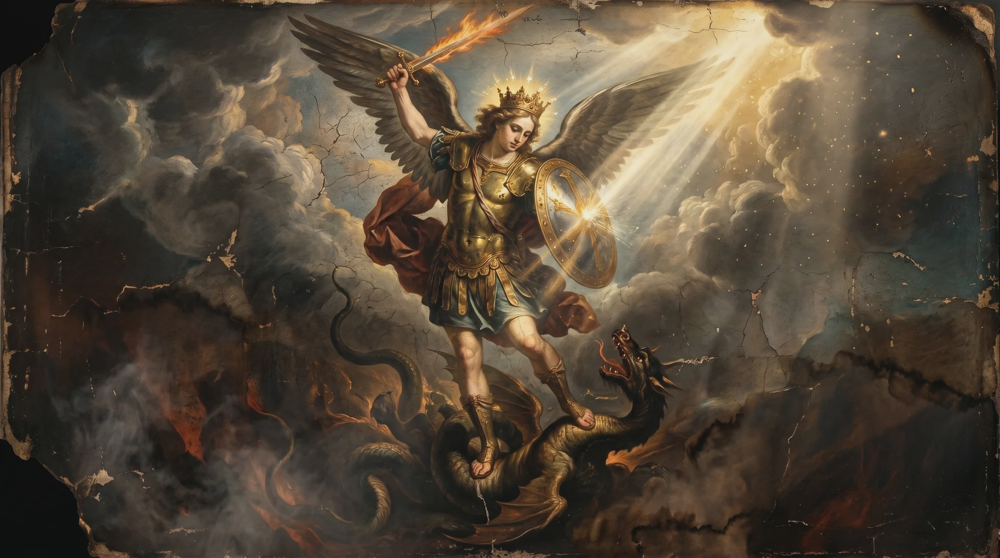
The Prayer to St Michael the Archangel is a short, forceful prayer for protection against the devil, invoking the prince of the heavenly host to defend us in battle. It was composed by Pope Leo XIII and prayed throughout the Church after Low Mass for generations. Here is the full text, in English and Latin, with its origin, how to pray it, and the longer exorcism form from which it grew.
The Prayer to St Michael the Archangel (text)
Saint Michael the Archangel, defend us in battle; be our protection against the malice and snares of the devil. May God rebuke him, we humbly pray; and do thou, O Prince of the heavenly host, by the power of God, cast into hell Satan and all the evil spirits who wander through the world for the ruin of souls. Amen.
That is the whole prayer. It is short enough to learn in a single reading, and the Church has loved it precisely because the soul under assault can reach for it at once, without a book.
The St Michael prayer in Latin
The Leonine original is in Latin, and it is well worth learning in the Church's own tongue:
Sancte Michaël Archangele, defende nos in proelio, contra nequitiam et insidias diaboli esto praesidium. Imperet illi Deus, supplices deprecamur: tuque, princeps militiae caelestis, Satanam aliosque spiritus malignos, qui ad perditionem animarum pervagantur in mundo, divina virtute, in infernum detrude. Amen.
Praying it in Latin joins us to the countless faithful who knelt with these very words at the foot of the altar across the Catholic world. For the Church's prayer in her ancient language, see The Latin Vulgate Bible.
Where the Leo XIII prayer comes from
The prayer was composed by Pope Leo XIII in 1886. He directed that it, with other prayers, be recited kneeling after Low Mass throughout the Latin Church — the petitions called the Leonine Prayers (three Hail Marys, the Salve Regina with its versicle and collect, and finally the invocation of St Michael). For nearly eighty years, until the rubrics were changed in the 1960s, priest and people knelt together after Mass and begged the great Archangel's defence — placing the Church first, in the Salve Regina, under the protection of Our Lady, to whom many of the faithful make a total consecration to Mary.
A tradition relates that Leo XIII composed the prayer after a vision of the assaults the devil would launch against the Church. Whatever the precise circumstances, the prayer reads exactly as it was meant to: a battle-cry of the Church Militant. You will find it returning at the close of the traditional Mass — see The Order of the Tridentine Mass.
How and when to pray the St Michael prayer
The prayer fits naturally into the Catholic day. The faithful traditionally pray it:
- After Mass, in the custom of the Leonine Prayers, kneeling.
- At the end of the Rosary, as a closing petition — see How to Pray the Rosary.
- In temptation or spiritual trouble, the instant the soul is under assault.
- Over the household, morning or evening, often alongside the Guardian Angel Prayer.
Many keep blessed holy water near the door and make the sign of the cross while saying St Michael's name — two of the Church's oldest defences joined in one act.
The longer form: Leo XIII's exorcism
The short prayer most Catholics know is the abbreviated end of a far longer text. In 1890 Leo XIII published a full Exorcism against Satan and the Apostate Angels, a solemn formula addressed to the prince of the heavenly host and intended, in its complete form, for the use of priests. The familiar short prayer is the portion the Pope adapted for the faithful and prescribed after Mass.
A point of order matters here. The solemn exorcism is a rite reserved to a priest acting under his bishop's authority; the lay faithful do not perform it. What every Catholic may and should pray is the short St Michael prayer given above — a deprecative prayer, asking God to act, open to all. Knowing that it is the tip of a great sword of the Church's authority only deepens our confidence in it.
St Michael in Sacred Scripture
The prayer draws its imagery from the Archangel as Holy Scripture reveals him. In the Apocalypse, St Michael is the captain of the heavenly armies against the dragon:
"And there was a great battle in heaven: Michael and his angels fought with the dragon, and the dragon fought, and his angels. And they prevailed not... And that great dragon was cast out, that old serpent, who is called the devil and Satan, who seduceth the whole world." (Apocalypse 12:7–9)
This is the very scene the prayer asks St Michael to renew for us: to cast into hell Satan and all the evil spirits.
In the Prophecy of Daniel, Michael is the prince who stands guard over the people of God:
"But at that time shall Michael rise up, the great prince, who standeth for the children of thy people." (Daniel 12:1)
He is named there twice more as "one of the chief princes" and "Michael your prince" (Daniel 10:13, 10:21). And the Epistle of St Jude records his contention with Satan over the body of Moses, where he answers not with his own power but with God's — "The Lord command thee" (Jude 9). This is exactly the temper of the prayer: "May God rebuke him." St Michael does not boast; he points to God. His very name carries the whole battle in a question — Quis ut Deus?, "Who is like God?" — the cry by which he answered the pride of Lucifer.
The Chaplet of St Michael the Archangel
Beyond the short prayer, the Church gives us a fuller devotion in the Chaplet of St Michael, which honours the nine choirs of angels — Seraphim, Cherubim, Thrones, Dominations, Virtues, Powers, Principalities, Archangels, and Angels. A tradition holds that St Michael revealed it to a Carmelite, Antónia d'Astónaco, in the early nineteenth century; it received the approval of the Holy See and an indulgence under Pope Pius IX in 1851.
The chaplet opens with an invocation and then offers one salutation to each of the nine choirs, each followed by an Our Father and three Hail Marys. The opening petition is brief and easily learned:
O God, come to my assistance. O Lord, make haste to help me. Glory be to the Father, and to the Son, and to the Holy Ghost; as it was in the beginning, is now, and ever shall be, world without end. Amen.
Then, for the first choir:
By the intercession of St Michael and the celestial choir of Seraphim, may the Lord make us worthy to burn with the fire of perfect charity. Amen.
The salutation continues choir by choir, asking through each a particular grace — the light of the Cherubim, the spirit of true humility of the Thrones, and so on. It closes with four Our Fathers honouring St Michael, St Gabriel, St Raphael, and one's Guardian Angel. For the full structure and the salutation of each choir, see the Chaplet of St Michael. It pairs naturally with the short St Michael prayer, which the faithful often add at its close.
St Michael's Lent (Michaelmas Lent)
There is also an older seasonal devotion to the great Archangel: St Michael's Lent, a penitential preparation of forty days kept from the Feast of the Assumption (15 August) to the Feast of St Michael, Michaelmas, on 29 September. The practice is associated above all with St Francis of Assisi, who is recorded as keeping this fast in honour of St Michael — it was during one such retreat, on Mount La Verna in 1224, that he received the sacred stigmata.
The devotion is not a fast prescribed by the Church's universal law, but a pious custom the faithful are free to take up: forty days of additional prayer, almsgiving, and self-denial offered in honour of St Michael and all the holy angels, crowned by his feast. Those who keep St Michael's Lent commonly pray the short St Michael prayer and the Chaplet daily through the season, and prepare for Michaelmas with the Novena to St Michael the Archangel in its final nine days.
Pray it together with the angelic host
The short prayer is the doorway; the Church offers fuller devotions to the great Archangel. The nine choirs of angels are honoured in the Chaplet of St Michael. The Novena to St Michael the Archangel prepares the soul for his feast on 29 September. And Michael does not stand alone: the Church also honours St Gabriel the Archangel and St Raphael the Archangel, the three archangels named in Scripture.
Frequently Asked Questions
What is the prayer to St Michael?
The Prayer to St Michael the Archangel is a short prayer for protection against the devil, begging the Prince of the heavenly host to defend us in battle and to cast Satan and all evil spirits into hell. It calls upon St Michael, whom Scripture names as the captain who fought the dragon (Apocalypse 12:7), to guard souls against "the malice and snares of the devil." It is a prayer of the Church Militant — the faithful on earth engaged in a real spiritual warfare for their salvation.
Who wrote the prayer to St Michael the Archangel?
The prayer was composed by Pope Leo XIII in 1886. He directed that it be recited, with other prayers, after Low Mass throughout the Latin Church — the petitions known as the Leonine Prayers. It is the abbreviated form of a longer exorcism the same Pope published in 1890. For generations priest and people knelt together after Mass to implore St Michael's protection against the powers of darkness.
When should I pray the St Michael prayer?
There is no wrong time, but the traditional moments are: after Mass (the Leonine custom), at the close of the Rosary, over the household morning and evening, and immediately in any moment of temptation or fear. Many pray it daily as a standing petition for the protection of body and soul.
Is the prayer to St Michael an exorcism?
The short prayer the faithful pray is not a solemn exorcism. The full Exorcism against Satan and the Apostate Angels (Leo XIII, 1890) is a rite reserved to a priest under his bishop's authority. The familiar St Michael prayer is the deprecative ending of that text, adapted for everyone — it asks God to rebuke the devil and is freely open to all the faithful.
Why is the prayer prayed after Mass?
Because Leo XIII prescribed it as one of the Leonine Prayers, said kneeling after every Low Mass. The custom sent the faithful out of the church armed against the enemy of souls. In the traditional Latin Mass this practice is widely kept to this day.
What is the Chaplet of St Michael?
The Chaplet of St Michael is a devotion honouring the nine choirs of angels, with a salutation to each choir followed by an Our Father and three Hail Marys. It was indulgenced by Pope Pius IX in 1851 and closes with four Our Fathers honouring St Michael, St Gabriel, St Raphael, and one's Guardian Angel. The short St Michael prayer is often added at its end. See the Chaplet of St Michael.
What is St Michael's Lent?
St Michael's Lent is a traditional forty-day penance kept from the Assumption (15 August) to Michaelmas, the Feast of St Michael (29 September), associated with St Francis of Assisi. It is a pious custom, not a prescribed fast: forty days of prayer, almsgiving, and self-denial in honour of St Michael and the holy angels, often kept by praying the St Michael prayer and Chaplet daily.
(Iter Fidei serves the Prayer to St Michael, in Latin and English with audio, in the app.) Download it here.
Sources. The Prayer to St Michael, Pope Leo XIII (1886); Exorcism against Satan and the Apostate Angels, Leo XIII (1890); the Leonine Prayers after Low Mass; the Chaplet of St Michael, indulgenced by Pope Pius IX (1851); St Michael's Lent and the tradition of St Francis of Assisi (La Verna, 1224); Holy Scripture, Douay-Rheims (Apocalypse 12; Daniel 10, 12; Jude 9).