
Prayer
Prayer to St Anthony, Finder of Lost Things
The traditional prayer to St Anthony for lost things, the formal Responsory Si quaeris miracula, why he is patron of what is lost, and how the prayer is rightly used.
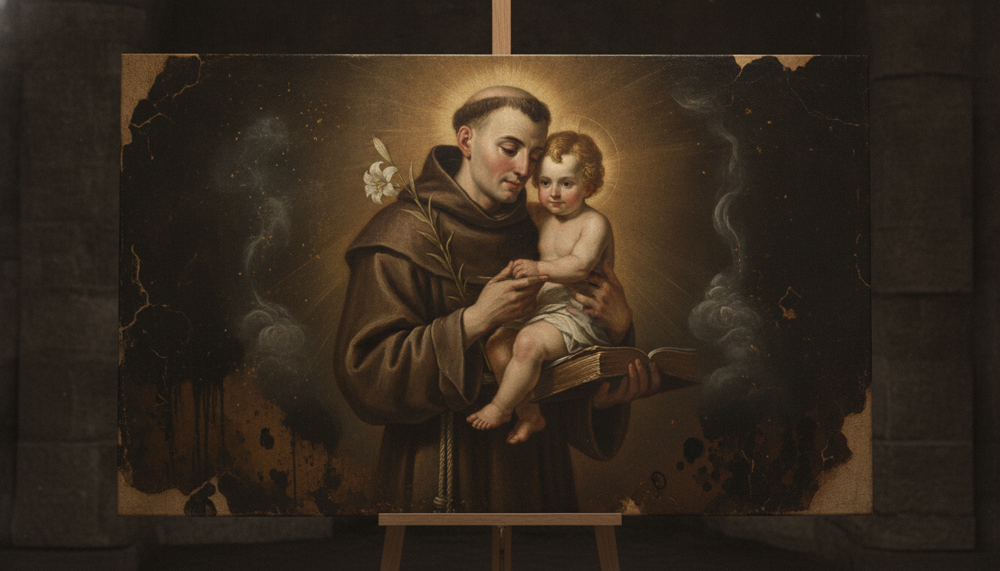
The traditional prayer to St Anthony for lost things is short and direct: Saint Anthony, Saint Anthony, please come around; something is lost and cannot be found. It is a homely petition that the faithful have whispered for generations when a possession goes missing, and beneath it lies the older and weightier Responsory of St Anthony, Si quaeris miracula. Both ask the same thing of the saint — not that he work magic, but that he carry our request to God, who alone restores what is lost. Below we give the authentic texts, explain why St Anthony is invoked as finder of lost things, and set out plainly how a Catholic prays them.
The traditional prayer to St Anthony for lost things
The familiar petition, learned at a grandmother's knee, runs in this form:
Saint Anthony, Saint Anthony, please come around;
something is lost and cannot be found.
It is often closed with a simple petition for his intercession:
O blessed St Anthony, the grace of God has made you a powerful advocate in all our needs and the patron for the restoring of things lost or stolen. I turn to you today with childlike love and deep confidence. You have helped countless people to recover things lost, material things, and, more importantly, the things of the spirit: faith, hope, and love. Come to my aid now, that I may regain what I have lost. But above all, I ask you to obtain for me a stronger faith and a deeper love of God. Amen.
There is also a rhyming jingle, Tony, Tony, turn around, something's lost and must be found, which circulates widely. We mention it because so many ask after it, but we do not commend it. A rhyme that treats the saint as a charm to be activated by a formula misses the whole point of the petition and edges toward superstition. The prayer above asks St Anthony to intercede; the jingle, taken as a spell, would have him perform. Keep the substance — the humble request that he pray for us — and let the cleverness go.
The Responsory of St Anthony — Si quaeris miracula
The older and more solemn prayer is the Responsory composed in the thirteenth century by Friar Julian of Speyer, sung in the Office of St Anthony and long indulgenced for private recitation. Its opening words, Si quaeris miracula, name the saint's reputation as a wonder-worker and end each strophe by asking his prayers:
If then you ask for miracles,
death, error, all calamities,
the leprosy and demons fly,
and health succeeds infirmities.The sea obeys, and fetters break,
and lifeless limbs you do restore;
while treasures lost are found again,
when young and old your aid implore.All dangers vanish at your prayer,
and direst need does quickly flee;
let those who know your power proclaim,
let Paduans say: these are of thee.The sea obeys, and fetters break,
and lifeless limbs you do restore;
while treasures lost are found again,
when young and old your aid implore.To Father, Son, may glory be,
and Holy Ghost, eternally.The sea obeys, and fetters break,
and lifeless limbs you do restore;
while treasures lost are found again,
when young and old your aid implore.V. Pray for us, blessed Anthony.
R. That we may be made worthy of the promises of Christ.
The line while treasures lost are found again — et membra resque perditas petunt et accipiunt in the Latin — is the source of St Anthony's title as finder of lost things. The Responsory has been prayed for nearly eight centuries, and where the modern jingle reduces him to a mascot, this prayer keeps him where he belongs: a friend of God whose intercession the whole Church has tested and trusted.
A short daily prayer to St Anthony
Many search for St Anthony's prayer not to recover a lost object but as a brief daily devotion to keep his intercession near. The faithful have long used this short form, which can be said each morning or at his shrine:
St Anthony, gentle and powerful in your help, your love for God and charity for His creatures made you worthy on earth to possess miraculous powers. Encouraged by this thought, I implore you to obtain for me the favour I desire — if it be the will of God. O gentle and loving St Anthony, whose heart was ever full of human sympathy, whisper my petition into the ears of the sweet Infant Jesus, who loved to be folded in your arms; and the gratitude of my heart will ever be yours. Amen.
It closes fittingly with the versicle of the Responsory: V. Pray for us, blessed Anthony. R. That we may be made worthy of the promises of Christ. This is the right shape of a devotion to St Anthony — not a formula to be triggered, but a daily turning of the heart to a friend in heaven who carries our prayers to the Christ-child he is so often shown holding.
Why St Anthony is the patron of lost things
The patronage rests on his miracles and on a famous incident of his own life. As a young friar, St Anthony had a psalter he used in teaching, annotated in his own hand. A novice who left the order took it with him; at Anthony's prayer the man was so troubled that he returned both the book and himself to the friary. From this recovery — of a lost book and a lost vocation together — grew the trust that God works through Anthony's prayers to restore what has gone astray. His full life, his preaching, and his feast on 13 June we treat in our profile of St Anthony of Padua; here we keep to the prayer.
The deeper ground is Scripture itself, where the recovery of what is lost is a figure of God's own mercy. Our Lord told the parable of the woman and her lost coin: "Or what woman having ten groats, if she lose one groat, doth not light a candle, and sweep the house, and seek diligently until she find it? And when she hath found it, she calleth together her friends and neighbours, saying: Rejoice with me, because I have found the groat which I had lost" (Luke 15:8-9, Douay-Rheims). The lost coin is a soul; its recovery is the joy of heaven over one sinner doing penance. When we ask St Anthony to find a lost thing, we touch — whether we know it or not — this far greater finding, and the prayer above is right to pass quickly from material things to "the things of the spirit: faith, hope, and love."
How a Catholic rightly prays to St Anthony
Here the tradition is firm, and we must be firm with it. To pray to St Anthony is not to work a spell, and the saint is not a power independent of God. The Catechism of St Pius X states it without ambiguity: we pray to God "in order that, as the author of graces, He may give us good things and deliver us from evils," and we pray to the saints "in order that they may intercede for us as our advocates with God." And it answers the very confusion the jingle breeds: "When we say that a Saint has granted a grace, we mean that this Saint has obtained it from God." The saint obtains; God grants. There is no other way to read a Catholic prayer to a saint, and any way of praying that forgets it has left the Faith behind.
This is the doctrine of the communion of saints, professed in the Creed: the blessed in heaven see God, and in God they see and love us, and their charity does not cease at death but is perfected. To ask St Anthony's prayers is exactly to ask what we would ask of a holy friend still living — that he carry our need to God. The same Pius X catechism counts it "very useful to pray to the Saints," and bids us pray particularly to our Guardian Angels, to St Joseph, to the Apostles, and to the saints whose name we bear. We may add St Anthony to that company in full confidence. For the wider practice of asking the saints to pray for us — and the answer to those who object to it — see why Catholics ask the saints to pray for them.
A few sober rules follow. Pray with faith and resignation, asking first for the greater good — a stronger faith, a recovered soul — and only then for the mislaid keys; the prayer that begins with the trinket and ends there has the order backwards. Do not bargain, do not treat the rhyme as a switch. If you wear a medal of St Anthony or keep his image, know that it is a sacramental — a holy sign that works not by any power in the metal but through the prayer and faith of the Church that blesses it, lifting the mind to God and to the saint's intercession. The medal does not find your keys; God does, sometimes through Anthony's prayers, and the medal is only a help to ask.
St Anthony of Padua and St Anthony the Great
Two saints share the name, and it is worth keeping them apart. St Anthony of Padua (1195-1231) is the Franciscan friar and finder of lost things who is the subject of every prayer above. St Anthony the Great (c. 251-356), also called Anthony of Egypt or Anthony Abbot, is a far earlier saint: the father of Christian monasticism, who withdrew into the Egyptian desert and whose life, written by St Athanasius, drew thousands after him into the eremitical life. His feast is 17 January; the Paduan's is 13 June.
When the faithful invoke St Anthony the Great they ask especially his help against temptation and the assaults of the devil, which he endured and overcame in the desert. A simple petition runs:
O glorious St Anthony, father of monks and conqueror of the powers of darkness, who in the desert overcame every temptation by prayer and fasting, obtain for me the grace to resist the snares of the enemy and to seek God alone. Pray for me, that I may be made worthy of the promises of Christ. Amen.
His example belongs to the same tradition of the desert from which the whole Church has drawn — the Desert Fathers, whose sober counsel on prayer and self-denial we hold dear. He is not the patron of lost things; that is the Paduan. But both are friends of God whose prayers the faithful rightly seek.
The company of the holy intercessors
St Anthony stands among the great intercessors the faithful have always invoked by name. For desperate and lost causes the Church turns to St Jude, the Apostle; for the household, for a holy death, and for the needs of the whole Church, to St Joseph, her patron, whom the Pius X catechism names first among the saints we ought to invoke; and to the Mother of God, through whom every grace is asked. Each is approached the same way: as an advocate before the throne of God, never as a power apart from Him. The fuller treasury of the tradition — litanies, novenas, and the prayers of the saints — we gather in our guide to Catholic prayers.
When you next lose something, say the old prayer as the Church teaches: Saint Anthony, please come around. You are not casting a charm. You are asking a friend in heaven to pray for you to the God who finds what is lost — coins, books, and souls alike — and rejoices over the finding.
Frequently Asked Questions
What is the prayer to St Anthony?
The traditional prayer to St Anthony is a humble petition asking the saint to intercede with God in our need: Saint Anthony, Saint Anthony, please come around; something is lost and cannot be found. The older and more solemn form is the Responsory Si quaeris miracula, composed in the thirteenth century and long indulgenced for private recitation. In every case the prayer does not ask the saint to work magic, but to carry our request to God, who alone restores what is lost.
What is the prayer to St Anthony for lost things?
The familiar prayer for lost things runs: Saint Anthony, Saint Anthony, please come around; something is lost and cannot be found, often joined to a fuller petition asking him to be "a powerful advocate" who helps us "regain what I have lost." St Anthony is invoked because Scripture itself makes the recovery of what is lost a figure of God's mercy, as in the parable of the lost groat (Luke 15:8-9, Douay-Rheims). Pray it with faith, asking first for the greater good — a stronger faith — and only then for the mislaid keys.
What is St Anthony the patron saint of?
St Anthony of Padua is best known as the patron of lost and stolen things, a patronage that grew from his recovered psalter and from the line of his Responsory, "while treasures lost are found again." He is also honoured as a patron of the poor, of travellers, and — as a great preacher and Doctor of the Church — of those who seek the truth. Above all the faithful ask him to help recover "the things of the spirit: faith, hope, and love."
What is St Anthony known for?
He is known for his miracles, for which the Responsory Si quaeris miracula praises him, and especially for restoring what is lost. In his own life he was a Franciscan friar, a powerful preacher whose sermons drew great crowds, and a teacher of such learning that he was named a Doctor of the Church. His feast is kept on 13 June; we give his full life in our profile of St Anthony of Padua.
Who was St Anthony?
St Anthony of Padua (1195-1231) was a Franciscan friar, born in Lisbon, who joined the order of St Francis and became one of its greatest preachers and teachers. The famous incident of his recovered psalter — a book and a wayward novice both restored at his prayer — is the root of his patronage over lost things. He died near Padua at the age of thirty-six and was canonised within a year.
Is St Anthony of Padua the same as St Anthony the Great?
No. St Anthony of Padua (1195-1231) is the Franciscan friar, patron of lost things, whose feast is 13 June and to whom the prayers above are addressed. St Anthony the Great (c. 251-356), the Egyptian hermit and father of monasticism, is a wholly different saint, kept on 17 January. When people speak of "the prayer to St Anthony" for lost things they almost always mean the Paduan.
The Iter Fidei app carries the Douay-Rheims Bible, the catechism, and the traditional prayers and devotions, in Latin and your own language. Download it here.
Sources. Catechism of St Pius X (1908), Part II, Ch. 4, On the Invocation of the Saints (it is "very useful to pray to the Saints"; the distinction between praying to God as author of graces and to the saints as advocates; "When we say that a Saint has granted a grace, we mean that this Saint has obtained it from God"); the Gospel of St Luke 15:8-9, the parable of the lost groat (Douay-Rheims); the Responsory of St Anthony, Si quaeris miracula, attributed to Friar Julian of Speyer (13th century), with its versicle Ora pro nobis, beate Antoni; the traditional account of St Anthony and his recovered psalter; the traditional short prayer to St Anthony ("St Anthony, gentle and powerful in your help..."); for St Anthony the Great (Anthony of Egypt, c. 251-356, feast 17 January), the Life of St Anthony by St Athanasius; the Apostles' Creed on the communion of saints.