
Prayer
The Litany of the Blessed Virgin Mary (Litany of Loreto)
The Litany of Loreto — the Marian litany par excellence, approved by Sixtus V in 1587 — its full text in English, its invocations, and how to pray it.
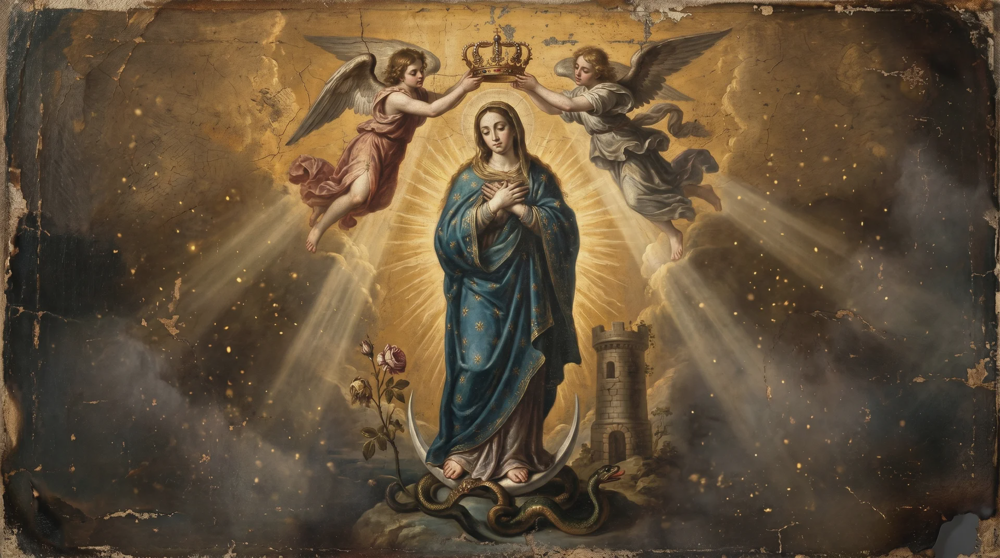
The Litany of the Blessed Virgin Mary — better known as the Litany of Loreto, from the shrine of the Holy House at Loreto where it was long sung — is the Marian litany par excellence. It was approved for the whole Church by Pope Sixtus V in 1587. In it, the Church calls on Our Lady under fifty titles, one after another, each answered by pray for us. Here is the litany in full, with a note on how to pray it.
How a litany is prayed
A litany is a prayer of invocation and response. The priest or leader says each invocation; the people answer. In the Litany of Loreto, the opening calls to God are answered have mercy on us; the long roll of titles of Our Lady is answered, each time, pray for us.
The Litany of Loreto
Lord, have mercy. Christ, have mercy. Lord, have mercy. Christ, hear us. Christ, graciously hear us.
God the Father of heaven, have mercy on us.
God the Son, Redeemer of the world,
God the Holy Ghost,
Holy Trinity, one God,Holy Mary, pray for us.
Holy Mother of God,
Holy Virgin of virgins,
Mother of Christ,
Mother of divine grace,
Mother most pure,
Mother most chaste,
Mother inviolate,
Mother undefiled,
Mother most amiable,
Mother most admirable,
Mother of good counsel,
Mother of our Creator,
Mother of our Saviour,
Virgin most prudent,
Virgin most venerable,
Virgin most renowned,
Virgin most powerful,
Virgin most merciful,
Virgin most faithful,
Mirror of justice,
Seat of wisdom,
Cause of our joy,
Spiritual vessel,
Vessel of honour,
Singular vessel of devotion,
Mystical rose,
Tower of David,
Tower of ivory,
House of gold,
Ark of the covenant,
Gate of heaven,
Morning star,
Health of the sick,
Refuge of sinners,
Comforter of the afflicted,
Help of Christians,
Queen of Angels,
Queen of Patriarchs,
Queen of Prophets,
Queen of Apostles,
Queen of Martyrs,
Queen of Confessors,
Queen of Virgins,
Queen of all Saints,
Queen conceived without original sin,
Queen assumed into heaven,
Queen of the most Holy Rosary,
Queen of peace,Lamb of God, who takest away the sins of the world spare us, O Lord
Lamb of God, who takest away the sins of the world graciously hear us, O Lord
Lamb of God, who takest away the sins of the world have mercy on us
Pray for us, O holy Mother of God That we may be made worthy of the promises of Christ
Let us pray Grant, we beseech Thee, O Lord God,
unto us Thy servants, that we may enjoy
perpetual health of mind and body ;
and, by the glorious intercession of blessed Mary ever Virgin,
be delivered from present sorrow
and enjoy eternal happiness.
Through Christ Our Lord.
When to pray it
The Litany of Loreto is sung or said in many places after the Rosary, on Saturdays (the day given to Our Lady), and through the month of May. It may be prayed by anyone, alone or with others; the long procession of titles is itself a meditation on who the Mother of God is — Virgin, Queen, refuge, gate of heaven.
It is one of the traditional Catholic litanies prayed by the Church.
The Litany of Loreto with the Rosary
The most common place to find the Litany of the Blessed Virgin Mary is at the end of the Rosary. After the five decades and the Hail, Holy Queen, many add the Litany of Loreto, then conclude with the closing versicle Pray for us, O holy Mother of God and the collect Grant, we beseech Thee, O Lord God. This pairing is especially fitting because the litany itself ends with the title Queen of the most Holy Rosary, pray for us — the Rosary and the litany praise the same Mother under the same crown.
To pray it this way: finish your Rosary as usual, then begin Lord, have mercy, recite the full roll of titles given above, and end with the prayer. It needs no priest; one voice may lead and another answer, or a single person may say both parts.
The full litany of the Blessed Virgin Mary
The text above is the full litany — fifty-odd Marian invocations, framed by the opening calls to the Holy Trinity and the closing Lamb of God and collect. Nothing is abridged. If you have seen shorter versions, they are excerpts; the complete Litany of Loreto runs from Holy Mary, pray for us all the way to Queen of peace, pray for us, in the order printed here.
The traditional Litany of Loreto
The traditional form is the litany as approved by Sixtus V in 1587 and prayed unchanged for centuries, with the small set of titles added by later Popes before 1958 — for example Help of Christians (added by Pius V after Lepanto), Queen conceived without original sin (Pius IX, 1846, following the definition of the Immaculate Conception), Queen of the most Holy Rosary (Leo XIII), and Queen of peace (Benedict XV, 1917). This is the form given in full above, and the form Iter Fidei prays.
New titles added to the litany
Several invocations have been inserted after 1958 — Mother of the Church and Mother of mercy (added 1980 and 1995), and Mother of hope, Solace of migrants, and Comfort of the migrants (added in 2020). These are genuine acts of the reigning Magisterium and may be prayed in good conscience; we simply note that they are recent additions and do not belong to the traditional text approved before 1958, which is the form we set out here. Those searching for the new litany of the Blessed Virgin Mary will find these the only difference from the older text.
The Litany of Loreto on EWTN and in print (PDF)
The litany is widely available — EWTN and most Catholic prayer books carry it — and the wording matches the text above, since it is a fixed, approved prayer. To print or save a PDF, the simplest course is to copy the litany as given here onto a single page; it fits easily, and you may add the opening and the collect so that the whole prayer is to hand for Saturdays, May devotions, or after the Rosary. There is no special edition required: one approved text serves the universal Church.
How the Litany of Loreto is sung
In Latin the litany has long been chanted rather than merely read — the cantor intones each title and the choir or congregation answers ora pro nobis. Recordings of the sung Latin Litany of Loreto are easy to find, and the simple back-and-forth makes it well suited to singing in procession or at the close of Benediction. Iter Fidei carries the litany with audio in both Latin and English, so the responses can be followed and prayed along.
The Holy House of Loreto in Italy
The litany takes its name from Loreto, a hill town in the Marches of Italy near Ancona, where the Holy House — venerated as the very house of Our Lady at Nazareth, in which the Annunciation took place — has been enshrined since the end of the thirteenth century. Pious tradition tells that the house was carried by angels from Nazareth in 1291, resting first in Dalmatia before coming to Loreto in 1294; the Church has never defined this account, but Popes from Julius II onward approved and enriched the shrine, and a great basilica was raised over the little house itself. It was the pilgrims singing Our Lady's praises there that made the Loreto litanies, as they were sometimes called, famous throughout Christendom. In 1920 Benedict XV declared Our Lady of Loreto patroness of aviators — a fitting title for the house said to have flown — and her feast is kept on the 10th of December. To pray the litany is thus to join, from wherever we are, the centuries of pilgrims who sang it within those walls.
Frequently Asked Questions
What is the Assumption of the Blessed Virgin Mary?
The Assumption is the truth that, at the end of her earthly life, the Blessed Virgin Mary was taken up body and soul into heavenly glory. The Church has held this from antiquity, and it is honoured each year on the feast of the Assumption, the 15th of August. The Litany of Loreto salutes this mystery in the invocation Queen assumed into heaven, pray for us.
How do you pray to the Virgin Mary?
We pray to Our Lady chiefly in the words the Church gives us: the Hail Mary, the Rosary, and litanies such as the Litany of Loreto, where we call upon her under each of her titles and answer pray for us. We do not adore her as we adore God; we ask her, as our Mother and Queen, to carry our needs to her Son. The litany above is a fitting way to begin, on Saturdays or through the month of May.
Why do Catholics pray to the Virgin Mary?
We pray to the Blessed Virgin not as to God, but as to the holiest of creatures and the Mother of our Redeemer, asking her intercession before His throne. At Cana she said to the servants, Whatsoever he shall say to you, do ye (John ii. 5), and her prayer moved her Son to His first miracle. We trust that the Mother whom Christ gave us from the Cross still pleads for us, sinners, now and at the hour of our death.
How many titles are in the Litany of the Blessed Virgin Mary?
In the traditional form approved before 1958, the litany invokes Our Lady under more than fifty titles, from Holy Mary and Holy Mother of God through the Mother, Virgin, and Queen invocations to Queen of peace. The exact count has grown by a handful over the centuries as Popes added titles such as Queen conceived without original sin and Queen of the most Holy Rosary. The full roll is printed above.
Is the Litany of Loreto the same as the Litany of the Blessed Virgin Mary?
Yes. Litany of Loreto and Litany of the Blessed Virgin Mary are two names for the same prayer. It is called the Litany of Loreto because it was long sung at the shrine of the Holy House at Loreto, and the Blessed Virgin Mary because every petition is addressed to her.
Can I pray the Litany of Loreto after the Rosary?
Yes, and it is the most common way to pray it. After the Hail, Holy Queen at the end of the Rosary, begin Lord, have mercy, recite the litany in full, and close with Pray for us, O holy Mother of God and the collect. The litany even ends with Queen of the most Holy Rosary, pray for us, which joins it to the Rosary you have just prayed.
Where is the Holy House of Loreto?
The Holy House stands at Loreto, in the Marches of central Italy, a few miles from Ancona and the Adriatic coast. It is enclosed within the Basilica della Santa Casa, whose marble screen, designed under Bramante, surrounds the plain stone walls venerated as the house of Nazareth. Pilgrims have come there since the Middle Ages, and it remains one of the great Marian shrines of the world.
What is the church of Our Lady of Loreto?
Properly it is the Basilica of the Holy House at Loreto, the sanctuary built over the Holy House itself. Because of the shrine's renown, many churches across the world have since been dedicated to Our Lady of Loreto, and they take their name from this one sanctuary and its litany.
For more, see liturgy of the hours.
(Iter Fidei serves the Litany of Loreto, in Latin and English with audio, in the app.) Download it here.
Sources. The Litany of the Blessed Virgin Mary (Litany of Loreto), approved by Pope Sixtus V (1587), in its form prior to 1958.